
Maintaining software created with AI coding agents is one of the most underestimated challenges in technology today. Developers and engineering teams across the world are discovering a hard truth: the same tools that ship features in hours can quietly bury a codebase in months. What starts as a speed advantage turns into a maintenance nightmare, and many teams never see it coming until it is too late.
By mid-2026, agentic coding is no longer experimental. Tools like Cursor, Devin, Claude Code, GitHub Copilot, and Gemini are writing real production code at unprecedented speed. But speed without understanding creates a new and dangerous class of technical debt, one that traditional auditing tools cannot even detect.
This article breaks down exactly why maintaining AI agent-generated software is so difficult, what the research data shows, what the specific failure modes look like in practice, and what developers can do right now to protect their codebases.
How Big Is the AI Coding Problem in 2026?
The numbers are striking. According to multiple industry sources tracking the shift through 2025 and into 2026, AI tools are now responsible for a substantial share of all code being written globally. The adoption curve is steep, and the maintenance debt is compounding at the same rate.
A large-scale empirical study tracking over 302,000 AI-attributed commits across nearly 6,300 public repositories found that the volume of unresolved technical debt from AI-generated code grew rapidly, climbing from a few hundred issues to over 100,000 surviving unresolved issues by February 2026. That is not a hypothetical risk. It is already in production systems worldwide.
The 80% Problem: Why AI Agents Stop Short of Production-Ready
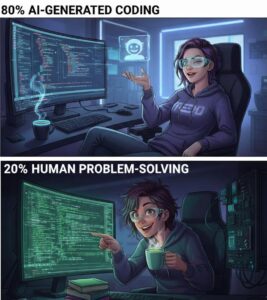
Google’s Addy Osmani named this phenomenon in early 2026, building on developer Andrej Karpathy’s observation that he had shifted to roughly 80% agent coding and 20% manual edits. Osmani’s insight is that the remaining 20% is not a minor cleanup task, it is the difference between code that works in a demo and code that survives real production traffic.
AI coding agents reliably skip the non-functional requirements that matter most in production environments. These include rate limiting, retry logic with backoff, circuit breakers, audit logging, PII handling, input sanitization, observability hooks, and security controls. These are not nice-to-have additions. They are what separates working software from production-grade software.
Comprehension Debt: The Maintenance Problem Nobody Measures
Traditional technical debt is well understood. You take a shortcut, you know you took it, and you plan to fix it later. AI-generated debt is different, because you often do not realize you are taking on debt at all. The term comprehension debt, coined by Addy Osmani in early 2026, captures this precisely.
Comprehension debt accumulates when developers ship code they did not write and do not deeply understand. Every time a team approves an AI-generated implementation without building a genuine mental model of how it works, they add to this debt. The problem only surfaces six to eighteen months later, when someone needs to modify, debug, or own that code.
CODE DUPLICATION IS SOARING
GitClear’s longitudinal study tracking 211 million lines of code found that copy-pasted code rose from 8.3% to 12.3% in AI-augmented projects, while refactored code fell from roughly 22% to around 10%. Every duplicated code block becomes an independent point of divergence. When a bug fix or schema change is required, every copy must be updated individually and teams rarely know how many copies exist.
CODE CHURN IS RISING FAST
A GitClear analysis of over 100 million lines of changed code found that code churn lines that are reverted or updated within two weeks of being written increased by 39% in projects heavily using AI coding tools. This is code being written, shipped, and then immediately needing to be fixed or replaced. It represents direct, measurable waste.
How to Maintain Software Built by AI Coding Agents: 8 Proven Practices
The teams that manage this well share a common approach. They treat AI output as a first draft, not a final product. They build governance into the workflow, not as an afterthought. Here is what the research and practitioner evidence supports.
1. Review AI output like a senior engineer, not a rubber-stamp approver
Every AI-generated commit requires human validation. The best-performing teams require that any developer can walk through and explain any code they commit, regardless of whether AI wrote it. This is non-negotiable.
2. Adopt spec-driven development
Make the specification the source of truth, with code as the derived artifact. Keep specifications alongside the code in structured Markdown files. This dramatically improves traceability and long-term maintainability by separating design from implementation.
3. Document the origin and intent of AI-generated code
Record where AI-generated sections came from, what edits were made, and the reasoning behind the implementation. Future developers including your future self will need this context when modifications are required.
4. Codify explicit workflow rules for agents
Write out your standards in a file the agent can reference: always write tests, always update documentation, never introduce new dependencies without flagging them, always add error handling before marking a task complete.
5. Track and audit AI-introduced issues over time
Tag commits authored or co-authored by AI assistants. Then track how many defects introduced in those commits still exist 30, 60, and 90 days later. This turns invisible debt into a measurable metric your team can act on.
6. Run duplicate code detection as a standard CI check
Tools like jscpd cover 150+ languages and catch near-duplicates that string-matching misses. GitClear’s industry average crossed 12% duplication in 2024 use that as a threshold for flagging repositories that need refactoring attention.
7. Enforce the missing 20% before shipping
Build a production readiness checklist that covers rate limiting, retry logic, circuit breakers, audit logging, PII handling, and input sanitization. Make this checklist part of the pull request review template.
8. Treat maintenance planning as part of the initial build
Design agent interfaces to be simple, well-documented, and modular from the start. Cloud-native, modular architecture is far easier to maintain than tightly coupled monolithic structures that agents tend to default to.
Frequently Asked Questions
1. Why is maintaining software built by AI coding agents so difficult?
AI coding agents generate code 5–7x faster than developers can understand it. This creates comprehension debt, where code ships but no one deeply understands how it works. When bugs appear or features need updating months later, developers must first reconstruct the intent of code they did not write. Combined with high duplication rates, missing error handling, and absent documentation, maintenance becomes extremely time-consuming and unpredictable.
2. What is comprehension debt in AI-generated code?
Comprehension debt accumulates when developers ship code they did not write and do not fully understand. An Anthropic internal study found that developers primarily using AI for code generation scored 50% on comprehension assessments versus 67% for those who wrote more code manually. This gap held across all experience levels, including senior engineers.
3. How much technical debt does AI-generated code create?
Research shows that unmanaged AI-generated code drives maintenance costs to 4x traditional levels by year two as technical debt compounds. A study of 302,600 AI-attributed commits found that over 100,000 AI-introduced issues were still unresolved in production codebases by February 2026, with a survival rate of 22.7% meaning more than one in five AI-introduced defects persists in the codebase long-term.
4. What is the 80% problem in agentic coding?
The 80% problem, named by Google’s Addy Osmani, describes how AI agents complete roughly 80% of a feature quickly, but skip the remaining 20% rate limiting, error handling, security controls, audit logging, PII handling, and input sanitization. These non-functional requirements determine whether code survives real production traffic, compliance audits, and failure conditions. The missing 20% is what turns a prototype into a maintenance liability.
5. What are the best practices for maintaining AI agent-generated software?
Key practices include treating AI output as a first draft requiring human review, adopting spec-driven development where specifications are the source of truth, documenting the origin and intent of AI-generated code, codifying explicit workflow rules for agents, tracking AI-introduced issues over time, running duplicate code detection as a standard CI check, enforcing production-readiness requirements before shipping, and building modular architectures from the start.
6. Does using AI coding agents lead to more security vulnerabilities?
Yes. Security is one of the most consistently missed elements in AI-generated code. A 2025 incident on the Lovable platform found that 10.3% of analyzed deployments leaked PII, financial records, and hardcoded API keys due to absent or misconfigured security policies in AI-generated code. The Harness State of Software Delivery 2025 report also found that the majority of developers spend more time resolving security vulnerabilities when using AI coding tools compared to traditional development.