
Here is a list of the best Python libraries used in Data Science and Machine Learning.
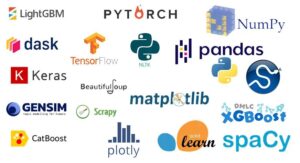
Python was created in 1991and that is over 30 years old, and it has never been more powerful. Most programming languages fade after a decade. Python, however, keeps growing. Today, it dominates AI research, data engineering, web development, cloud computing, and university curricula worldwide. Python has 8.2 million active users, according to SlashData, with 69 percent of machine learning engineers and data scientists adopting the language. Python’s vast ecosystem of libraries makes it easier to solve complex problems and build powerful solutions. So what makes Python the most popular programming language in 2026?
The answer is not just one thing. It is a combination of simplicity, community, corporate support, and an unmatched library ecosystem. Let’s break it all down.
Python Libraries for Data Science
This blog will cover some of the best Python libraries for machine learning and data science. analyzing on their purposes, these libraries have been divided into data processing and model deployment, data mining and scraping, and data visualization.
- Table of Contents
Python Libraries for Data Science
Python Libraries for Data Processing and Model Deployment
1) Pandas
2) NumPy
3) SciPy
4) Sci-Kit Learn
5) PyCaret
6) Tensorflow
7) OpenCV
Python Libraries for Data Mining and Data Scraping
8) SQLAlchemy
Python Libraries for Data Visualization
9) Matplotlib
Python Libraries for Data Science, Python Libraries for Data Processing and Model Deployment
- Pandas
Pandas is generally used for data manipulation, analysis, and cleaning. Pandas is well suited for different kinds of data, including: Tabular data with heterogeneously-typed columns
Ordered and unordered time series data, arbitrary matrix data with row & column labels
Unlabelled data and any other form of observational or statistical data sets. If your data could fit in a spreadsheet, Pandas handles an effective way to analyze data requires the ability to index, retrieve, split, join, restructure, and various other analyses on both multi and single-dimensional data. It reads from CSV, Excel, SQL, JSON, Parquet, and more. Furthermore, it integrates directly with NumPy, Matplotlib, and scikit-learn, making it the connective tissue of most Python data pipelines.
Key Features of Pandas
- DataFrame object for data manipulation with integrated indexing.
- Tools for reading and writing data between in-memory data structures and different file formats.
- Data alignment and integrated handling of missing data.
- Reshaping and pivoting of data sets
- Label-based slicing, fancy indexing, and subsetting of large data sets.
- Data structure column insertion and deletion.
- Group by engine allowing split-apply-combine operations on data sets.
- Hierarchical axis indexing to work with high-dimensional data in a lower-dimensional data structure.
- Time series-functionality: Date range generation[4] and frequency conversion, moving window statistics, moving window linear regressions, date shifting and lagging.
Provides data filtration.
How to install Pandas?
To install Python Pandas, go to your command line/ terminal and type “pip install pandas” or else, if you have anaconda installed in your system, just type in “conda install pandas”. Once the installation is completed, go to your IDE (Jupyter, PyCharm, etc.) and simply import it by typing: “import pandas as pd”
Python Pandas Operations
Using Python pandas, you can perform a lot of operations with series, data frames, missing data, group by etc.
- NumPy
Numpy is an essential package for scientific computing in Python. The main strength of Python for Data Science is the availability of one key library, namely Numpy, that enables leveraging SIMD (same instruction multiple data) vectorization.nNumpy (and then in turn Scipy and the sci-kits) made it easy to build efficient matrix-based computations while using a high-level general-purpose language (unlike Matlab), which is really important for the adoption by the scientists and applied mathematicians. NumPy is widely used in various fields such as machine learning, data science, and engineering due to its powerful capabilities.
Key Features of Numpy
Multidimensional Arrays: NumPy introduces the ndarray (n-dimensional array) object, allowing storage and processing of multidimensional arrays in Python. Elements in NumPy arrays are all required to be of the same data type, allowing efficient numerical calculations.
Broadcasting: NumPy arrays support broadcasting, an incredibly useful mechanism where smaller arrays (or scalars) can be automatically expanded to be compatible for arithmetic operations with larger arrays without making extra copies. This makes vectorization easy and efficient.
Indexing and Slicing: NumPy arrays support fast and convenient indexing and slicing operations for accessing and manipulating data in arrays. Fancy indexing is also supported for more advanced cases.
Numerical Operations: A large collection of numerical operations and methods are implemented in NumPy, including arithmetic, statistics, linear algebra, histograms, etc. These operations are fast as they are implemented in pre-compiled C code.
Interoperability: NumPy provides excellent interoperability with many other scientific computing libraries and tools, like SciPy, Matplotlib, Pandas, scikit-learn, TensorFlow and more. Transferring NumPy arrays to and from these tools is seamless and efficient.
Memory-efficiency: The internal memory representation of NumPy arrays is compact and homogeneous, leading to reduced RAM usage and better performance when working with large n-dimensional datasets compared to native Python lists of lists.
A typical NumPy lab may include tasks such as creating arrays of different shapes, performing element-wise operations, reshaping arrays, applying mathematical functions, and visualizing data using tools like Matplotlib.
In a NumPy lab setting, participants often get practical experience in working with numerical data efficiently using NumPy’s array operations and functions. This hands-on approach helps reinforce the concepts learned and allows individuals to gain proficiency in using NumPy for various computational tasks.
SciPy
SciPy is a library of software for engineering and science. Furthermore, you need to understand the difference between SciPy Stack and SciPy Library. SciPy contains modules for linear algebra, optimization, integration, and statistics. The main functionality of SciPy library is built upon NumPy, and its arrays thus make substantial use of NumPy. It provides efficient numerical routines as numerical integration, optimization, and many others via its specific submodules. The functions in all submodules of SciPy are well documented, another coin in its pot.
It is used for advanced mathematical operations on NumPy data. Some of the key features of SciPy are: Optimization, Fourier transforms, Signal processing, Probability, and Statistics.
Sci-Kit Learn
Sci-Kit Learn was designed for specific functionalities like image processing and machine learning facilitation. In this regard, it is referred to the savior and bone of the most prominent of these packages is scikit-learn. The package is built on the top of SciPy and makes heavy use of its math operations.
The scikit-learn exposes a concise and consistent interface to the common machine learning algorithms, making it simple to bring ML into production systems. The library combines quality code and good documentation, ease of use and high performance and is de-facto industry standard for machine learning with Python.
PyCaret
PyCaret is an open-source, low-code machine learning library in Python that simplifies the machine learning workflow. It provides a streamlined interface for data preparation, modeling, evaluation, and deployment of machine learning models. With PyCaret, users can easily compare and select the best model from a variety of options, perform hyperparameter tuning, and generate automatic reports. It also supports various data types, such as structured, time-series, and text data.
Key Features of PyCaret
1. PyCaret is a low-code library that can help you save time.
2. It’s a basic and easy machine learning library.
3. It allows you to design quickly and efficiently from the comfort of your notebook.
4. It gives a ready-to-use solution.
Tensorflow
Tensorflow is designed to achieve deep learning algorithm in heterogeneous devices.
Key Features of Tensorflow
- Tensorflow supports asynchronous training: Asynchronous training is supported naturally by concurrent execution of replicated subgraphs. In addition, synchronous training is also possible in distributed tensorflow.
2. Tensorflow supports parameter-server & worker structure: in distributed tensorflow user can assign a device with either ps task or worker task.
3. Tensorflow supports input data shuffle and batch: facilitated by queue structure, tensorflow allows batch & shuffle input at each iteration. Users can control the batch size/ whether to shuffle/ epoch limits of input data.
4. Subgraph execution is a key feature of tensorflow. User can specify partial graph to execute. This provides the flexibility of testing and the possibility of reuse.
OpenCV
OpenCV is an open source C++ library for image processing and computer vision, originally developed by Intel, later supported by Willow Garage and and is now maintained by Itseez. It is free for both commercial and non-commercial use. Therefore you can use the OpenCV library even for your commercial applications.
Key Features of OpenCV
1. Optimized for real time image processing & computer vision applications
2. Primary interface of OpenCV is in C++There are also C, Python and JAVA full interfaces
3. OpenCV applications run on Windows, Android, Linux, Mac and iOS
Optimized for Intel processors.
1. Speed
2. versatile
3. cross-Platform
Python Libraries for Data Mining and Data Scraping
SQLAlchemy
SQLAlchemy is the standard Python library for database interaction. It provides two distinct layers: a Core SQL expression language for writing database-agnostic queries, and an ORM layer that maps Python classes to database tables. Both approaches are genuinely useful, depending on the complexity of your data access patterns. It also delivers SQL statements and schema to users. SQLAlchemy ORM is a self-contained object-relational mapper. SQLAlchemy allows developers to control their databases while also automating redundant activities.
Python Libraries for Data Visualization
Matplotlib
Matplotlib is the foundational visualization library in Python. It has been the default charting tool for over 20 years, and almost every other Python visualization library builds on top of it. It gives you complete control over every element of a chart — axes, labels, colors, fonts, layouts, and annotations. matplotlib is a 2D graphical Python library. However, it also supports 3D graphics, but this is very limited. https://www.projectpro.io/article/matplotlib-projects-in-python/752