
Antimatter propulsion may be the only realistic path to interstellar travel. No other fuel source produces more energy per gram. When matter and antimatter meet, they annihilate completely — converting 100% of their mass into pure energy. That makes antimatter roughly 10 billion times more energetic than chemical rocket fuel and about 1,000 times more powerful than nuclear fission.
The catch? Making antimatter is extraordinarily difficult, and the cost today borders on the absurd. But across the coming centuries, the scale of investment required to send a crewed mission to another star system could reach a number so large it almost defies comprehension: a trillion times a trillion dollars.
That is not an exaggeration. It is the logical consequence of the physics, the engineering, and the sheer scale of the challenge. This article breaks it all down — what antimatter actually is, why it is the leading candidate for interstellar propulsion, and what humanity will need to build before a starship ever leaves the solar system.
Antimatter Starship Mission — Key Facts
- Where Does AI Fit Into Interstellar Mission Planning?
Artificial intelligence is already reshaping how scientists approach the challenge of interstellar travel. AI systems are accelerating research across every relevant domain — materials science, particle physics simulation, mission trajectory optimization, and autonomous spacecraft control.
- AI and Antimatter Research
Producing antimatter efficiently requires tuning particle accelerators with extraordinary precision. AI-driven optimization systems can model billions of parameter combinations far faster than human researchers. DeepMind’s AlphaFold demonstrated how AI can compress decades of scientific progress into months. Similar approaches are being explored for plasma physics and accelerator design.
- Autonomous Navigation Over Light-Years
At 50% of the speed of light, communication delays with Earth would be measured in years. A crewed or uncrewed starship cannot wait for instructions. It needs onboard AI systems capable of making autonomous decisions about navigation, systems management, and emergency response — potentially over decades of continuous operation.
- Mission Simulation and Planning
AI models will be essential for simulating thousands of mission scenarios — testing different fuel loads, thrust profiles, crew compositions, and contingency plans before a single component is built. This kind of simulation work, compressed by AI, could shave centuries off the development timeline.
- What Is Antimatter — And Why Does It Matter for Interstellar Travel?
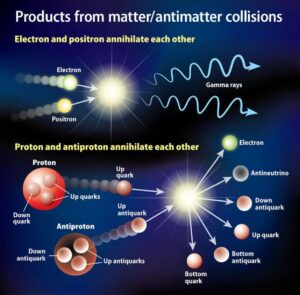
Every particle of matter has a corresponding antiparticle with the same mass but opposite charge. The antiparticle of an electron is a positron. The antiparticle of a proton is an antiproton. Together, they form antihydrogen — the simplest form of antimatter.
When antimatter contacts ordinary matter, both are destroyed in a process called pair annihilation. This releases energy in the form of gamma rays and charged pions, according to Einstein’s famous equation E=mc². No other reaction in nature is this efficient. Chemical combustion converts less than 0.001% of mass to energy. Nuclear fission converts about 0.1%. Antimatter annihilation converts 100%.
The Rocket Equation Problem
Space travel is constrained by the Tsiolkovsky rocket equation. The faster you want to go, the more fuel you need — and carrying more fuel adds weight, which requires even more fuel. This creates an exponential problem for long-distance travel.
Chemical rockets top out at about 0.00005% the speed of light. Even nuclear pulse propulsion — the most advanced near-term concept — can theoretically reach 3–5% of light speed. At that pace, a trip to Proxima Centauri would take roughly 80–140 years. Antimatter propulsion, by contrast, could theoretically achieve 50–80% of the speed of light, cutting the journey to under a decade.
Key Point: An antimatter engine does not “burn” fuel the way a rocket does. It annihilates fuel. The energy released per unit of reaction mass is fundamentally higher than any other process allowed by the laws of physics. This is why serious interstellar mission studies always return to antimatter.
- How Much Antimatter Would an Interstellar Mission Actually Need?
Studies by NASA’s Institute for Advanced Concepts (NIAC) and independent physicists estimate that a crewed starship capable of reaching Proxima Centauri in a reasonable timeframe would need roughly 10 to 1,000 metric tons of antimatter, depending on the mission profile, ship mass, and whether deceleration is included.
Even the lower estimate — 10 metric tons — translates to 10 million grams of antimatter. At today’s production cost of approximately $62.5 trillion per gram, that amounts to roughly $625 sextillion just for the fuel. And that assumes the price never changes.
- The Production Gap Is Almost Unimaginable
CERN, the world’s most advanced particle physics laboratory, produces about 1 to 10 nanograms of antihydrogen per year. A nanogram is one billionth of a gram. At that rate, producing 10 metric tons of antimatter would take approximately 10 quintillion years — far longer than the current age of the universe.
This is not a financial problem. It is an engineering and physics problem. Current accelerator technology is fundamentally inefficient at antimatter production — most of the input energy is wasted. Future civilizations will need to build entirely new classes of antimatter factories, likely powered by fusion reactors or orbital solar arrays capturing the full output of the sun.
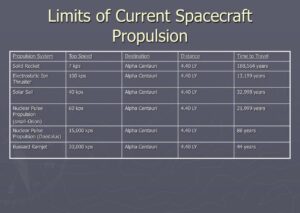
PROPULSION SYSTEMS COMPARED
- CHEMICAL ROCKETS
Max Speed: ~0.005% of light speed
Time to Proxima Centauri: ~85,000 years
Status: Operational
- NUCLEAR PULSE (ORION)
Max Speed: 3–5% of light speed
Time to Proxima Centauri: ~80–140 years
Status: Theoretical
- LASER SAIL (STARSHOT)
Max Speed: ~20% of light speed
Time to Proxima Centauri: ~20 years (probe only)
Status: Early research
- FUSION RAMJET
Max Speed: 10–20% of light speed
Time to Proxima Centauri: ~20–40 years
Status: Theoretical
- ANTIMATTER ANNIHILATION
Max Speed: 50–80% of light speed
Time to Proxima Centauri: ~5–10 years
Status: Far future
- Why the Total Cost Could Reach a Trillion Times a Trillion Dollars
A trillion times a trillion is one septillion — written as a 1 followed by 24 zeros. The entire global economy today generates roughly $105 trillion per year. A septillion dollars is about 10 billion times the current world GDP.
How could any project cost that much? The answer is scale and time. An antimatter-powered interstellar mission is not a project — it is a civilizational undertaking. It requires:
1. ANTIMATTER PRODUCTION INFRASTRUCTURE
Building factories capable of producing metric tons of antimatter will require particle accelerators orders of magnitude more powerful than anything that exists today. These facilities may need to be constructed in space, powered by dedicated fusion reactors or Dyson swarms. Their construction and operation across decades or centuries will represent the single largest engineering expenditure in history.
2. ANTIMATTER STORAGE AND CONTAINMENT
Antimatter cannot touch ordinary matter. It must be stored in magnetic traps, called Penning traps, that require continuous power and precise engineering. Scaling these from nanogram quantities to metric tons introduces entirely new classes of engineering problems. A containment failure means total annihilation of the spacecraft.
3. THE STARSHIP ITSELF
A crewed interstellar vessel capable of surviving a multi-decade journey through deep space — with redundant life support, radiation shielding, closed-loop ecosystems, and an antimatter engine — would be the most complex structure ever built. Its construction cost alone, even with advanced manufacturing, could dwarf the cost of every space program in human history combined.
4. RESEARCH, DEVELOPMENT, AND ITERATION
Before a crewed mission is possible, centuries of research will be needed. Unmanned probes, failed experiments, abandoned technologies, and incremental improvements will all carry price tags. The total R&D spend across generations of scientists and engineers adds another enormous layer to the cost.
Perspective: The Apollo program cost roughly $280 billion in today’s dollars. The International Space Station has cost approximately $150 billion. A mature antimatter starship program would likely cost more than the combined economic output of the entire 21st century — and that is before accounting for production scaling.
- Is This Actually Worth It? The Case for Interstellar Investment
The question of whether humanity should spend unfathomable sums to reach another star is not purely economic. It is existential.
Physicist Stephen Hawking argued repeatedly that humanity’s long-term survival requires becoming a multi-planetary and ultimately multi-stellar species. A single catastrophic event — an asteroid impact, a supervolcano, a self-inflicted civilizational collapse — could end Earth-bound humanity entirely. Interstellar colonization is, in that framing, the ultimate insurance policy.
There is also the straightforward argument from curiosity. The discovery of a living world around another star — or even the ruins of one — would be the most significant event in human history. No price tag changes that.
And the economic argument, counterintuitively, works in favor of the investment. Technologies developed for antimatter production and interstellar propulsion would have cascading benefits across energy, medicine, computing, and materials science. The Manhattan Project produced nuclear medicine. The Apollo program produced GPS, memory foam, and water filters. A civilization-scale antimatter program would transform human technology entirely.
Frequently Asked Questions About Antimatter Propulsion and Interstellar Travel
1. Why is antimatter the best fuel for interstellar travel?
Antimatter releases more energy per gram than any other fuel source known to physics. When matter and antimatter collide, they annihilate completely and convert 100% of their mass into energy, following Einstein’s E=mc². No chemical or nuclear fuel comes close to this energy density.
2. How much does it cost to make antimatter today?
CERN currently produces antiprotons at a cost estimated between $62.5 trillion and $100 trillion per gram. This makes antimatter the most expensive substance ever manufactured by humans — by an enormous margin.
3. How long would it take to reach Proxima Centauri with antimatter propulsion?
With a mature antimatter drive capable of reaching a significant fraction of the speed of light, a trip to Proxima Centauri — 4.24 light-years away — could take between 5 and 40 years depending on the acceleration profile and fuel efficiency.
4. What is a trillion times a trillion dollars?
A trillion times a trillion equals one septillion dollars, written as $1,000,000,000,000,000,000,000,000. The entire world’s GDP today is roughly $105 trillion — a septillion dollars is about 10 billion times larger than that.
5. Are there any real projects working on antimatter propulsion?
Yes. NASA has funded antimatter propulsion research through its Institute for Advanced Concepts (NIAC). The Breakthrough Starshot project explores light-sail alternatives for probe-scale missions, but antimatter remains the leading theoretical candidate for crewed interstellar travel.
5. How is AI involved in interstellar mission planning?
AI is accelerating antimatter research through accelerator optimization, materials discovery, and plasma physics simulation. For the missions themselves, onboard AI will be essential for autonomous navigation and decision-making across multi-decade voyages where communication with Earth is impossible in real time.
Final Thoughts
Antimatter propulsion is not science fiction. The physics is sound. The engineering is real. The challenge is one of scale and time — and both of those are, ultimately, solvable problems for a civilization committed to the stars.
A trillion times a trillion dollars is not a number that fits easily in the human mind. But across centuries of civilizational development, driven by AI-accelerated science and exponentially growing economies, it becomes conceivable. What seems impossible today has a way of becoming inevitable given enough time and determination.
Humanity’s first interstellar mission will not be a national project. It will be a species-level achievement. And when it launches, every dollar, every experiment, every failed prototype, and every generation of researchers will have contributed to it.