
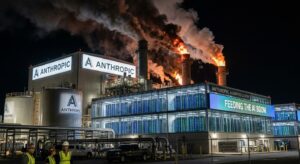
Anthropic, the company behind Claude, is reportedly expanding beyond leased data center capacity into dedicated infrastructure backed by natural gas power plants, according to details attributed to its October 26, 2026, S-1 filing. The reported projects include a 710-megawatt gas plant in Bastrop County, Texas, and a proposed 1.6-gigawatt facility near Waco, alongside a data center project in Rockdale, Texas, and a planned site near Dalby, Queensland, Australia.
The reported expansion highlights a growing challenge for the AI industry: securing enough reliable electricity to power increasingly demanding models. With grid connections often delayed and data centers requiring continuous power, natural gas is emerging as one option for meeting demand. However, the proposed projects also raise questions about emissions, water use, and the environmental costs of expanding AI infrastructure.
In This Article
- What Anthropic’s IPO Filing Reveals About Its Data Center Strategy
- Inside Anthropic’s Reported Texas Data Center Expansion
- Anthropic’s Planned Expansion Into Australia
- Why AI Data Centers Are Turning to Natural Gas
- Why Anthropic’s Energy Projects Face Local Opposition
- Anthropic’s Natural Gas Strategy and Its Climate Commitments
Anthropic’s S-1 filing, made public on October 26, 2026 ahead of a planned IPO, detailed a meaningful strategic shift: the company is moving away from simply leasing data center capacity from cloud providers and toward developing dedicated facilities of its own, with direct involvement in securing the natural gas power that runs them. Axios, which reviewed the filing, called it a move that pulls Anthropic “deeper into the energy supply chain.”
That shift matters because it changes Anthropic’s risk profile. Building and co-developing power plants introduces supply-chain exposure and capital requirements that simply renting server space never did — but it also gives Anthropic more control over the compute capacity it needs to train and run Claude at scale, positioning it to compete more directly with Big Tech rivals like Microsoft, Google, and Amazon, who’ve already built extensive in-house power infrastructure of their own.
Central Texas has become the clearest proving ground for Anthropic’s energy strategy, with the company tied to at least three major data center projects in the region.
Anthropic is reportedly in talks to lease a data center campus on a 2,842-acre site in Cedar Creek, developed by BlackChamber Partners and Pacifico Energy. The site would include a dedicated 710-megawatt natural gas power plant, using simple-cycle gas turbines, to support roughly 490 megawatts of IT capacity. A related $366 million filing, dubbed “Project Longhorn,” shows construction aiming to begin in late November 2026.
Anthropic has already signed a data center lease in Rockdale, at the site of a former Alcoa aluminum smelter, reportedly worth $9.1 billion and potentially scaling toward $16 billion.
McLennan County: the Waco plant
Separately, Anthropic has signed leases for a data center campus near Waco that would be paired with its own 1.6-gigawatt natural gas power plant one of the largest dedicated power commitments reported for any single AI data center project to date.
| Texas project | County | Power source | Scale |
|---|---|---|---|
| Cedar Creek / Project Longhorn | Bastrop | 710 MW gas plant | $366M–$2.2B |
| Rockdale (former Alcoa site) | Milam | Grid-connected | $9.1B lease |
| Waco-area campus | McLennan | 1.6 GW gas plant | Not fully disclosed |
Anthropic’s First Australian Data Center Runs on Gas Too
Anthropic’s energy strategy isn’t confined to the U.S. The company has signed a lease to become the first major tenant of the proposed $22 billion Western Downs Digital Park, developed by Singaporean firm Zerra DC near Dalby, Queensland, Anthropic’s first data center presence in Australia.
The site sits above one of Australia’s largest gas basins, with more than 6,000 gas wells already operating in the region, and the facility would connect to a grid that includes both coal and natural gas generation. That’s notable because Australia’s prime minister had pledged in July 2026 that tech companies would be required to power AI data centers with renewable energy a commitment this project puts directly to the test.
Anthropic has said it intends to pursue virtual power purchase agreements, with a stated preference for renewable sources, though it has acknowledged that which specific projects will supply that power remains an ongoing discussion. The Australian facility will reportedly not be used to train Claude, due to local copyright law, but will support the model in answering user queries.
Why AI Companies Are Choosing Gas Over Renewables
Anthropic isn’t acting alone, it’s following an industry-wide pattern. A Cleanview market intelligence report found that nearly 75% of power equipment planned for on-site generation at data centers nationwide is natural gas, with 46 data centers planning their own on-site power totaling a combined 56 gigawatts.
The core reason is speed. AI training and inference require constant, around-the-clock power, the kind combined-cycle gas turbines can reliably deliver, but solar and wind cannot without substantial battery storage. Grid connection delays stretching years have pushed companies toward power they can secure now, even at higher long-term cost, rather than wait for cheaper renewable capacity to come online later. Texas alone has nearly 58 gigawatts of natural gas power in various stages of planning or construction, and nearly half of the power plants currently under construction in the state are being built exclusively to serve data centers, without connecting to the broader regional grid.
In Texas, residents near Cedar Creek have packed county commissioner meetings raising concerns about the gas plant’s environmental impact, and Austin officials have separately considered new zoning restrictions including a possible ban on data center development within city limits. In Australia, farmers near the proposed Dalby site say decades of gas industry extraction have already drained their bore water, even as some are now being offered access to that same water to help build the AI facility that would sit nearby.
More broadly, Wikipedia’s tracking of AI data center opposition found that by July 2026, local community resistance had already blocked construction of AI data center projects worth some $130 billion in the U.S. alone, a sign that the gas-and-data-center buildout model is drawing organized resistance well beyond any single company’s projects.
The Tension With Anthropic’s Own Climate Position
There’s a real tension worth naming here. Anthropic has previously published policy recommendations including a “Build AI in America” proposal that explicitly called for accelerating permitting for geothermal, natural gas, and nuclear power generation to meet AI’s electricity demands, citing leading forecasts that AI data centers would need 14 to 19 gigawatts of electricity by 2028. At the same time, Anthropic has positioned itself publicly as one of the more safety- and responsibility-focused AI labs.
Those two positions aren’t necessarily contradictory a company can advocate for faster permitting across multiple power sources, including renewables, while pragmatically building with gas because it’s what’s available fastest. But it does mean Anthropic’s actual build-out, gas plants in Texas and a gas-and-coal-connected site in Australia, sits in meaningful tension with the “preference for renewables” language the company uses publicly. Readers evaluating Anthropic’s climate footprint should weigh the stated intentions against what’s actually being permitted and built on the ground.
Key Talking Points
- Anthropic’s October 2026 S-1 filing revealed a shift toward dedicated, self-built data centers with direct involvement in natural gas power procurement.
- The company is tied to at least three major Texas data center projects, including a 710 MW gas plant in Bastrop County and a 1.6 GW gas plant near Waco.
- Anthropic’s first Australian data center, near Dalby, Queensland, would connect to a grid supplied by coal and gas, despite a national push for renewable-only AI power.
- Industry-wide, nearly 75% of on-site data center power equipment being planned nationally is natural gas, driven by AI’s need for constant power and years-long grid connection delays.
- Local opposition in both Texas and Australia centers on water access, air quality, and a lack of transparency from developers.
- Anthropic’s gas-heavy build-out sits in tension with its own past advocacy for accelerated renewable and multi-source power permitting.
Frequently Asked Questions
1. Why is Anthropic building natural gas power plants?
Anthropic needs constant, round-the-clock electricity to train and run Claude at scale. Natural gas turbines can provide reliable power, while solar and wind may require costly battery storage to deliver electricity consistently. Years-long delays connecting new facilities to existing power grids have also pushed Anthropic, like other AI companies, toward power sources it can secure faster.
2. Where are Anthropic’s natural gas data center projects located?
Anthropic’s confirmed and reported gas-linked projects are concentrated in Central Texas, including Bastrop County (Cedar Creek), Milam County (Rockdale), and McLennan County (near Waco). Another reported project is near Dalby, Queensland, Australia, where the proposed facility would connect to a grid powered by coal and natural gas.
3. How much natural gas power is Anthropic planning to use?
Reported figures include a 710-megawatt gas plant in Bastrop County and a 1.6-gigawatt gas plant near Waco. These figures represent substantial power commitments associated with AI data center development.
4. Is Anthropic’s gas plant buildout controversial?
Yes. Residents near the proposed Bastrop County site have raised concerns about air quality and water access, prompting county commissioners to request a formal public hearing with Texas environmental regulators. Farmers near the proposed Australian site have also raised concerns about water access.
5. Does Anthropic use renewable energy at all?
Anthropic has said it intends to pursue power purchase agreements, with a stated preference for renewable energy sources, particularly for its Australian facility. However, the specific renewable energy projects that would supply that facility have not been finalized.