
The question is not whether AI is powerful. It clearly is. The real question is: what do we want it to do with that power?
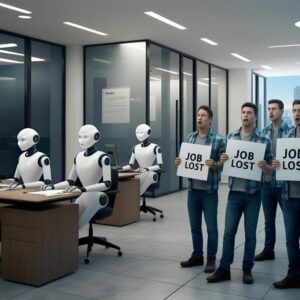
Most people, when asked directly, have a clear answer. According to Harvard Business School research published in February 2026, 94% of people favor using AI as a collaborative tool to assist humans — rather than a replacement for them. https://www.library.hbs.edu/working-knowledge/riley-performance-resistance-2026 . That is not a fringe opinion. It is a near-universal one. And yet, the headlines keep pushing the opposite story. Therefore, this article does something different. Instead of feeding the fear, it follows the evidence — through real workplaces, real data, and real human voices — to reach a clear conclusion.
IN THIS ARTICLE
- The Fear vs. The Facts
- What MIT Research Actually Found
- Radiologists: AI Made Them Better, Not Redundant
- Creativity Study: 100,000 Humans vs. AI
- Klarna: What Happens When You Go Too Far
- The Three Rules Every Organization Must Follow
- Who is At Risk- And Who Is Not
- Frequently Asked Questions
The Fear vs. The Facts Every week brings a new headline. “AI is taking our jobs.” “Millions face automation.” The fear is loud, constant, and emotionally powerful, but the numbers tell a different story. In 2025, 1.2 million people in the US lost their jobs. Of those, only 55,000 layoffs — just 4.5% — were directly attributed to AI. The rest came from cost pressures, slower demand, and post-pandemic restructuring. The same forces that have always driven workforce cuts.
4.5% of total US layoffs in 2025 were directly caused by AI — not the mass replacement the headlines promised. Source: Elite Brains, 2026
Furthermore, a December 2025 survey of 1,000 hiring managers found that 59% admit they emphasize AI in layoff announcements because it sounds more strategic than admitting financial constraints. Forrester calls this “AI washing.” In other words, AI is being blamed for decisions that were never really about AI. ” AI’s real impact on jobs in 2026 is less about mass replacement and more about slowing new hiring, companies letting natural attrition do the work. The panic is real. The apocalypse is not.”
WHAT IS ACTUALLY HAPPENING INSTEAD
According to MIT Sloan research, the number of human-intensive tasks — tasks that cannot be effectively done by machines , has been increasing, not decreasing, between 2016 and 2024 (MIT Sloan). Moreover, Forrester’s 2026 predictions reveal that over half of layoffs attributed to AI will be quietly reversed. Companies discover, too late, that they cannot actually replace those humans with current AI systems.
- What MIT Research Actually Found
The most thorough academic analysis of AI and work was published by MIT Sloan in 2025. Researchers studied not just job titles, but the structure of individual tasks within jobs — which is a much more precise way to measure AI’s real impact. Their conclusion was striking. AI is more likely to complement human workers than replace them.
AUGMENTATION VS. AUTOMATION — THE CRITICAL DIFFERENCE
The researchers drew a sharp line between two outcomes. Automation transfers a task entirely from human to machine. Augmentation, however, uses AI to make a human worker more productive in that task , and often in other tasks too. Augmentation allows humans to do things they simply could not do before. For example, advanced microscope tools augmented scientists’ ability to work within nano-scale worlds. AI does the same for knowledge workers — it does not replace the scientist; it gives the scientist a better microscope.
“Augmentation allows humans to do things that they couldn’t do before , it is not just partial automation, but a genuine expansion of human capability.” –MIT SLOAN MANAGEMENT REVIEW, 2025
Additionally, tasks newly added to the Bureau of Labor Statistics dataset in 2024 show higher complexity and human-centricity than the tasks that disappeared. The economy is not simplifying. It is becoming more human. Think of it this way.
Advanced microscopes did not replace scientists. They gave scientists a better tool to see further. AI does exactly the same for knowledge workers. It does not replace the expert. It gives the expert a better instrument.
- Radiologists: AI Made Them Better, Not Redundant
For a decade, the headline was clear: AI will replace radiologists. Deep learning models were reading scans with 94% accuracy. The replacement seemed inevitable. It did not happen. Instead, something more interesting did. Rather, something more interesting did. American hospitals in 2025 faced radiologist shortages — not surpluses. AI expanded capacity. It reduced burnout. It
caught errors human eyes missed. But it did not eliminate the need for human expertise.
WHAT RADIOLOGISTS SAID THEMSELVES
“Sometimes I have missed very small areas, and the AI has picked it up. It makes us think twice — to make sure that area is either abnormal or not.”
— CONSULTANT STROKE PHYSICIAN, UNIVERSITY OF BIRMINGHAM STUDY, 2026
Meanwhile, American hospitals in 2025 faced radiologist shortages , not surpluses. AI expanded capacity. It reduced burnout. It did not eliminate the need for human expertise. Additionally, 85% of radiologists are now optimistic that AI will improve patient outcomes, according to Philips’ 2025 Future Health Index. That is not thesentiment of a profession being erased. That is the sentiment of a profession beingempowered. https://www.philips.com/a-w/about/news/archive/features/2025/ai-in-radiology-three-keys-to-real-world-impact.html .That is not the sentiment of a profession being erased. That is the sentiment of a profession being empowered.
- Creativity Study: 100,000 Humans vs. AI — Who Won?
In January 2026, researchers from the Université de Montréal, Google DeepMind, and the University of Toronto published the largest creativity study ever conducted between humans and AI. They tested 100,000 human participants against large language models on divergent creative tasks.
THE RESULT WAS NOT WHAT EITHER SIDE EXPECTED
AI produced creative outputs faster. Humans, however, produced outputs that were more original, more contextually meaningful, and more emotionally resonant at the highest levels of creativity. More importantly, the researchers concluded that AI functions best as a creative assistant, expanding human ideas and opening new paths for exploration — rather than as a creative replacement.
“Rather than signaling the end of creative careers, the findings suggest a future where AI serves as a creative assistant, helping amplify human imagination rather than replace it.”
— PROFESSOR KARIM JERBI, UNIVERSITÉ DE MONTRÉAL, SCIENTIFIC REPORTS, JANUARY 2026
In other words, the most thorough scientific test of human vs. AI creativity concluded that humans and AI together outperform either one alone. The future is collaboration — not competition.
- Klarna: What Happens When You Go Too FarKlarna provides the most instructive, and most honest, AI case study of the decade. It shows exactly what happens when the “serve, not replace” principle is ignored.
In 2024, Klarna cut over 700 human customer service agents and replaced them with AI chatbots. The decision was celebrated in tech media as bold and forward-thinking. By 2025, the reality was different. Customer satisfaction scores dropped. Complex complaints went unresolved. The human judgment that AI was supposed to replace turned out to be irreplaceable. Klarna began rehiring. Quietly. Consequently, this became one of the clearest real-world proofs that AI should serve humans, not replace them, not because of sentiment, but because of operational reality. Customers noticed. Revenue followed.
- The Three Rules Every Organization Must Follow The evidence from medicine, fintech, software, and creative fields all points to the same three principles. These are not opinions. They are patterns that emerge consistently across every sector studied.
RULE 1 — LET AI OWN REPETITION. LET HUMANS OWN JUDGMENT.AI is exceptional at high-volume, pattern-based tasks. Fraud detection, image flagging, routing tickets, writing boilerplate code — these are AI’s natural territory. Humans, however, are exceptional at nuanced judgment. Diagnosing edge cases. Negotiating disputes. Reading a room. Feeling when something is wrong that no dataset could predict. Consequently, any organization that blurs this line will see performance suffer — exactly as Klarna did.
RULE 2 — THE HUMAN MUST STAY ACCOUNTABLE.
An AI can flag a suspicious lung nodule. A radiologist must decide what to do next. An AI can detect a fraudulent transaction. A compliance officer must authorize the response. Accountability cannot be delegated to a model, legally, ethically, or practically. This is not a limitation of AI. It is a feature of responsible deployment.
RULE 3 — PATIENCE IS STRATEGY, NOT WEAKNESS.
GitHub Copilot takes 11 weeks before developers realize its full productivity gains. Radiology AI tools take months to integrate into intuitive clinical workflows. Rushing adoption to cut costs is how organizations end up reversing course, at significant expense. Moreover, Forrester predicts that over half of AI-related layoffs in 2026 will be quietly reversed as organizations discover the operational reality of premature replacement. Therefore, moving thoughtfully is not slow — it is smart.
- Who Is Actually at Risk — And Who Is Not
Not every worker faces the same pressure from AI. The data is specific about which roles are vulnerable, and which are growing. Additionally, the WEF Future of Jobs Report 2025 found that while robots and AI may displace approximately 5 million jobs globally, the same report forecasts the creation of entirely new role categories in AI governance, data ethics, and human-AI collaboration that did not previously exist.
“Workers most at risk are those doing predictable, repetitive, rules-based work. The solution is not to fear AI — it is to become the person in the room who uses AI better than anyone else. That person is not going anywhere. In fact, they are in higher demand than ever.”
—WEF FUTURE OF JOBS REPORT, 2025
TAKEAWAY
AI should serve humans, not replace them. Not because of sentiment but because of evidence. Every real-world test of full replacement has failed. Every study of human-AI collaboration has succeeded. The most powerful version of AI is one that makes humans more capable, not one
that removes them from the picture. The organizations that understand this will outperform those that do not. The workers who embrace this will thrive while others scramble.
Frequently Asked Questions
- Is AI really replacing human jobs right now?
Yes, but far less than headlines suggest. In 2025, only 4.5% of total US layoffs were directly caused by AI. The rest came from cost pressures, restructuring, and slower demand.
Furthermore, 59% of hiring managers admit they use AI as the reason for cuts that were really budget-driven. Forrester predicts that over half of announced AI layoffs in 2026 will be quietly reversed when companies discover they cannot operationally replace those workers.
- How is generative AI reshaping customer service in small businesses?
Generative AI is revolutionizing customer service in small businesses by providing instant, 24/7 support through intelligent chatbots and virtual assistants. It helps businesses respond to customer inquiries faster, improving satisfaction and reducing response times. By analyzing customer behavior and preferences, AI can deliver personalized recommendations that enhance the overall customer experience. Small businesses also benefit from lower operational costs, as AI automates repetitive tasks such as answering FAQs and managing appointments. As generative AI continues to evolve, it is becoming a powerful tool for helping small businesses compete more effectively and build stronger customer relationships.
- Can AI replace humans in every aspect?
AI cannot replace humans in every aspect. While AI can automate repetitive tasks, process vast data, and outperform humans in narrow, well-defined domains, it fundamentally lacks consciousness, genuine understanding, moral reasoning, creativity rooted in lived experience, and physical dexterity in complex unstructured environments. The more accurate framing is: AI augments humans, not replaces them.
- Which jobs are most at risk from AI in 2026?
Jobs most vulnerable to AI in 2026 are those involving repetitive digital tasks, including data entry, basic customer support, routine content creation, and simple administrative work. Roles requiring judgment, creativity, leadership, relationship-building, and domain expertise remain significantly more resilient.”
The real divide in 2026 won’t be AI vs humans. It will be humans using AI vs humans who aren’t.
Deepfake Detection Techniques in 2026: How to Spot and Prevent Synthetic Media