
Why Tesla now behaves like an AI company that happens to build cars and what that means for every automaker racing to catch up.
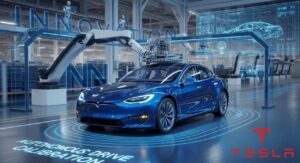
Who is driving the shift? Tesla, under Elon Musk’s direction, has spent the past two years converting itself from a car manufacturer into what it calls “a real-world AI company.” What changed? Full Self-Driving (FSD), the Cybercab robotaxi, the Optimus humanoid robot, and Tesla’s own AI training silicon now sit at the center of the company’s valuation story, not just its car sales. When did this become undeniable? Through 2026, as FSD v14 rolled out fleet-wide and the driverless Cybercab moved from prototype to public testing in Austin. Where is this playing out first? Austin, Texas — Tesla’s regulatory testbed for autonomy with ripple effects across Detroit, Shenzhen, and Silicon Valley. Why does it matter? Because if Tesla’s AI bet pays off, the industry’s value shifts from who builds the best steel to who builds the best software brain. How is Tesla doing it? Through vertically integrated hardware, in-house chips, and a data flywheel no legacy automaker can easily replicate.
In this article
- Tesla’s core AI thesis
- Full Self-Driving: the software at the center
- Cybercab and the robotaxi bet
- Where AI shows up across the Tesla model lineup
- What it means for Tesla stock
- Impact on the wider automotive industry
- Risks and open questions
- FAQs
Tesla’s Core AI Thesis: Cars as a Software Platform
Most automakers still think in terms of horsepower, trim levels, and dealership margins. Tesla’s bet is different: it treats every car it sells as a rolling sensor platform that feeds a central neural network. Every mile driven by a tesla model on the road whether a model y tesla, a model 3 tesla, or a model x tesla becomes training data for the next FSD release.
That’s the flywheel: more cars on the road generate more edge-case data, which trains better models, which make the cars more capable, which sells more cars. Legacy automakers building EVs from scratch don’t have that loop running yet. Tesla has been running it since 2019.
Full Self-Driving: The Software at the Center of Everything
tesla fsd is no longer a driver-assist feature bolted onto the car, it’s the product Tesla is actually trying to sell. Tesla began unifying FSD v14 across both its Hardware 3 and Hardware 4 fleets in August 2026, bundling a “Lite” build for older cars with the fuller v14.3.7 release for newer ones. The goal is a single neural architecture across the whole fleet instead of fragmented versions.
This matters because Hardware 3 cars, some of the oldest in the fleet were never expected to run modern FSD well. Tesla’s answer was to distill what the newer Hardware 4 network learned into a lighter model that older chips can run. That’s a genuinely hard engineering problem, and getting it to work at scale is a meaningful signal that Tesla’s AI team, not just its factory, is where the company’s edge now lives.
- What FSD v14 actually changed
- Reinforcement learning and offline model refinements, previously exclusive to Hardware 4, distilled down to Hardware 3.
- Smoother lane centering and fewer false slowdowns in ordinary driving.
- New parking, unparking, and reversing capability without driver input.
- Wider rollout of “Hey Grok” voice control and expanded Grok AI availability inside the cabin
Executives have framed the next release, FSD v15, as a “step-function” leap comparable to the jump from v13 to v14 — a larger parameter count and wider context window that JPMorgan analysts flagged as the real inflection point for scaling the Robotaxi network.
- Cybercab and the Robotaxi Bet
The clearest expression of Tesla’s AI-first identity is the Cybercab: a two-seat vehicle with no steering wheel and no pedals, built specifically to run on FSD with zero mechanical fallback for a human driver. Tesla confirmed plans in August 2026 to publicly launch Cybercab in Austin, beginning with employee rides ahead of a wider public rollout.
Where a tesla model y 2026 retrofitted for Robotaxi duty is still fundamentally a personal car wearing a taxi hat, Cybercab is purpose-built. It exists only because Tesla is confident enough in its AI stack to remove the human backup entirely. That’s a statement of intent as much as a product launch.
Tesla’s driverless footprint is still small next to the competition. Reporting from August 2026 put Tesla’s unsupervised Austin fleet at roughly 17 vehicles, down from about 25 in spring, against Waymo’s driverless-mile lead of roughly 580-to-1. The AI strategy is ambitious; the deployment is early.
Where AI Shows Up Across the Tesla Model Lineup
AI isn’t confined to one flagship product at Tesla, it’s layered across the entire tesla model range, along with the energy and insurance products built around it.
Model Y, Model 3, and Model X
The model y tesla remains the volume leader and the primary vehicle used in Tesla’s existing Robotaxi service in Austin. The model 3 tesla continues as the entry point into the FSD ecosystem, while the model x tesla serves the higher-end segment with the same underlying self-driving stack. All three share one neural network architecture rather than model-specific software, which is part of why OTA updates can roll out fleet-wide rather than car-by-car.
Tesla Roadster
The long-delayed tesla roadster remains more of a halo project than a near-term AI showcase, but Tesla has continued to reference a next-generation Roadster in its roadmap discussions through 2026, tying it loosely to the same performance and software platform as the rest of the lineup.
Supporting infrastructure: Supercharger, Solar, Insurance, Lease
Tesla’s AI ambitions don’t stop at the car. The tesla supercharger network feeds charging and routing data back into trip-planning software. tesla solar and Powerwall products use similar predictive load-balancing logic. tesla insurance, meanwhile, prices premiums using real driving-behavior data pulled directly from the car’s sensors, a model legacy insurers using self-reported mileage simply can’t match. And for buyers who’d rather not commit long-term, a tesla lease lets them access the latest FSD hardware without owning it outright, which keeps more cars cycling through Tesla’s data pipeline faster.
What It Means for Tesla Stock
tesla stock has increasingly moved on AI and robotaxi headlines rather than quarterly delivery numbers alone. Shares climbed toward the $350 range in the third week of August 2026, a roughly 17% move off the late-July low, largely on Cybercab and AI-feature news rather than vehicle sales data. Morningstar has maintained a fair value estimate implying meaningful upside, with analysts attributing a large share of that valuation directly to the robotaxi business rather than car manufacturing.
That’s the clearest evidence that Wall Street has already re-rated Tesla as an AI company. Investors are pricing in a future where software margins, not vehicle margins, drive the bulk of the company’s value.
Impact on the Wider Automotive Industry
Tesla’s AI-first posture is forcing a response across the industry, even from manufacturers who’d rather compete on traditional strengths like ride quality or brand heritage.
The data flywheel problem
Legacy automakers can license autonomy software from suppliers, but they can’t easily replicate Tesla’s fleet-scale data advantage. Every tesla model on the road is a data collection point; competitors selling far fewer AI-equipped vehicles simply generate less training signal per year.
Vertical integration as a moat
Tesla designs its own inference chips, writes its own neural network training software, and controls the vehicle hardware end to end. That vertical stack is expensive to build but hard to copy quickly and it’s part of why competitors like Rivian have leaned toward partnerships rather than building the full stack alone.
Insurance, energy, and beyond
The tesla insurance and tesla solar businesses show how Tesla treats AI as a company-wide capability rather than a car feature. That template using real-time behavioral and usage data to reprice a traditionally static product is now something insurers and utilities outside Tesla are studying directly.
xAI Explained: Inside Elon Musk’s AI Company After the SpaceX Merger
Risks and Open Questions
- Safety scrutiny: Removing the steering wheel entirely, as Cybercab does, raises the regulatory and liability bar in a way that supervised FSD in a normal car does not.
- Scale gap versus Waymo: A roughly 580-fold driverless-mile deficit is a real gap, not a rounding error, and it will take years of consistent deployment to close.
- Hardware fragmentation: Running one unified AI stack across old Hardware 3 cars and new Hardware 4 cars is technically difficult, and early builds have shown regressions that had to be patched.
- Valuation dependence on a not-yet-proven business: A meaningful share of Tesla’s current stock valuation already assumes robotaxi success that hasn’t been demonstrated at scale.
Frequently Asked Questions
1. Is Tesla really an AI company now, or still primarily a car company?
Tesla still manufactures and sells cars as its primary revenue source today, but its leadership and a growing share of investors value it on AI-driven businesses — FSD, Cybercab, and Optimus — rather than vehicle sales growth alone. It’s best described as a car company using AI to try to become something bigger.
2. What is the difference between Tesla FSD and Cybercab?
FSD is the software: a driver-assistance and autonomy system installed in ordinary Tesla vehicles, including the model y tesla and model 3 tesla. Cybercab is a dedicated hardware product, a purpose-built vehicle with no steering wheel that only exists because Tesla trusts its FSD software enough to remove human controls entirely.
3. How does Tesla’s AI strategy affect Tesla stock price?
Tesla stock has shown increasing sensitivity to AI and robotaxi milestones, sometimes moving more on Cybercab or FSD news than on quarterly delivery figures. Analysts have attributed a significant portion of Tesla’s valuation directly to the robotaxi opportunity.
4. Which Tesla models get the newest AI features first?
Vehicles with Hardware 4 (AI4) — Tesla’s newer computer platform — generally receive the latest FSD versions first, with Hardware 3 cars receiving a “Lite” version later. This applies across the lineup, from the model 3 tesla to the model x tesla.
5. Can I get Tesla’s self-driving features on a leased car?
Yes. A tesla lease includes the same hardware as a purchased vehicle, and FSD can typically be added as a subscription or one-time purchase depending on the vehicle and region.
Key Takeaways
- Tesla’s AI strategy centers on a data flywheel: more cars on the road generate more training data for FSD, which improves the cars, which sells more cars.
- FSD v14’s unification across Hardware 3 and Hardware 4 fleets, and the anticipated step-change in FSD v15, are the technical core of that strategy.
- Cybercab represents Tesla’s clearest bet on full autonomy, a vehicle with no human-driving fallback at all.
- Wall Street has already partly re-rated Tesla stock around AI and robotaxi potential rather than car sales alone.
- The gap to established autonomy leaders like Waymo remains large, and regulatory and safety scrutiny will likely intensify as Cybercab scales.
AI Sphere Hub — AI news and education for global and African audiences.