
Microsoft is selling OpenAI’s most advanced models to China’s largest tech companies — a market OpenAI and Anthropic refuse to enter directly. One contract clause explains the entire split.
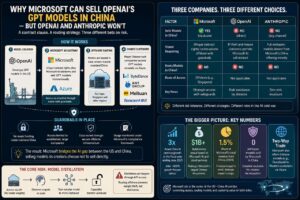
Microsoft has quietly built one of the most unusual positions in the global AI industry: it sells OpenAI’s GPT models to Chinese technology giants, while OpenAI itself — the company that built those models won’t touch the Chinese market directly. Anthropic stays out entirely too. The arrangement, first detailed in Bloomberg reporting this month, raises a question that cuts to the center of the US-China AI rivalry: if the model’s own creator considers the risk too high, why doesn’t the company selling it?
The answer is not about ethics versus profit, even though it can look that way at first glance. It comes down to a contract clause, a routing trick, and three companies making very different bets on how the next phase of the AI cold war will play out.
- What Microsoft Is Actually Doing in China
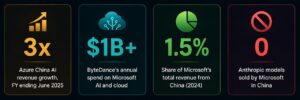
Microsoft sells access to OpenAI’s GPT series through its Azure cloud platform to some of China’s largest internet companies. ByteDance, the parent company of TikTok, has become Microsoft’s biggest Chinese AI customer and is on track to spend more than $1 billion a year on Microsoft’s AI and cloud services. Ant Group, Meituan, and Tencent also buy AI model access through Azure, according to people familiar with the matter.
The growth has been dramatic. Azure’s AI revenue in China roughly tripled in the fiscal year ending June 2025, following close to 400% growth the year before. A former Microsoft chief commercial officer reportedly told staff that the company occupies a position no competitor holds acting as the connective layer between the AI hubs of the US West Coast and China’s east coast tech industry.
- The Revenue Is Small, But the Position Is Not
Despite the rapid growth, Microsoft President Brad Smith has told US lawmakers that China accounts for only around 1.5% of total company revenue. The financial stakes, in other words, are modest relative to Microsoft’s overall business. The strategic stakes are a different story entirely. Microsoft has positioned itself as the only Western AI vendor with meaningful, sanctioned access to China’s largest tech companies a foothold that competitors and policymakers alike are watching closely.
- Why OpenAI and Anthropic Refuse to Sell Directly
Both OpenAI and Anthropic have stayed out of the Chinese market for two stated reasons: intellectual property theft and misuse risk. Neither company wants its frontier model weights anywhere near Chinese infrastructure, and neither wants to be in the position of monitoring how its models are used by companies operating under different legal and political constraints than US customers.
Anthropic’s stance is the more absolute of the two. Its models are entirely absent from Microsoft’s China lineup not sold, not licensed, not routed through any intermediary. OpenAI’s position is narrower: it won’t sell directly, but it has not blocked Microsoft from doing so under the terms of their partnership.
- The Distillation Problem
The deeper concern is something called model distillation — a technique where a company can train a smaller, cheaper model to mimic a larger one’s behavior just by observing its outputs. Critically, this does not require access to a model’s underlying weights. It can be done entirely through API calls, which is exactly the kind of access Microsoft is selling. Routing models through offshore servers prevents weight theft. It does not prevent distillation.
Why this matters: If distillation is possible through ordinary API access, then keeping data centers out of China solves only part of the problem. The capability transfer can still happen — just more slowly, and at greater cost to whoever is replicating the model.
The Contract Clause That Makes This Possible
Microsoft’s ability to sell GPT models into China comes down to a single structural fact: its partnership agreement with OpenAI gives Microsoft the right to set its own terms for selling those models internationally. This is a singular arrangement no other OpenAI partner or customer has it. In practice, it means Microsoft can serve a market that OpenAI’s own leadership has decided is too risky to enter directly.
Microsoft has added its own guardrails on top of that contractual freedom. It restricts sales to established, large companies rather than opening access broadly, and it does not host OpenAI models inside mainland China. Instead, Chinese customers reach the models remotely through Azure data centers located outside the country, with regional hubs like Singapore playing a key role in that routing.
- What This Means for the Broader AI Industry
This arrangement lands at a politically sensitive moment. Just weeks earlier, a separate US government directive forced Anthropic to suspend access to its most advanced models worldwide over export control concerns — a sign that Washington is paying close attention to exactly this kind of frontier-model access question. Microsoft’s China business, structured through contract and geography rather than direct sales, sits in a regulatory gray zone that lawmakers may not leave alone for long.
- A Two-Way Trade
The arrangement runs in both directions. Microsoft has also tested and made available Chinese-developed models, including DeepSeek, to Western customers through Azure — meaning Microsoft profits on both legs of the US-China AI trade simultaneously. It sells American models into China and Chinese models into the West, collecting a margin on each transaction.
- A Warning for Smaller Markets
For businesses and policymakers outside the US and China including across Africa and other emerging AI markets this story is a preview of how frontier AI access will likely be brokered going forward: not through the model makers themselves, but through cloud intermediaries with the contractual flexibility to operate where the original developers won’t. Understanding who actually controls access to these models, rather than who built them, will matter increasingly for any country trying to plan its AI strategy.
Frequently Asked Questions About Microsoft, OpenAI, and China
1. Does Microsoft sell OpenAI’s GPT models in China?
Yes. Microsoft sells access to OpenAI’s GPT series through Azure to major Chinese technology companies, including ByteDance, Ant Group, Meituan, and Tencent. This was first detailed in Bloomberg reporting in June 2026.
2. Why won’t OpenAI and Anthropic sell their AI models directly in China?
Both companies cite intellectual property theft and misuse risks. They are concerned that direct access could allow Chinese firms to distill or replicate their model capabilities, and that the models could be misused in ways the companies cannot control or monitor.
3. How is Microsoft able to sell OpenAI’s models in China if OpenAI won’t?
Microsoft holds a unique contractual arrangement with OpenAI that gives it the right to set its own terms for selling GPT models internationally, including in China. This effectively makes Microsoft a middleman selling a product its own creator declines to sell directly.
4. Does Microsoft host OpenAI models inside China?
No. Chinese customers access the models remotely through Azure data centers located outside mainland China, including hubs like Singapore. This routing reduces the risk of model weight theft, though it does not prevent model distillation through API calls.
5. How much revenue does Microsoft’s China AI business generate?
Azure’s AI revenue in China roughly tripled in the fiscal year ending June 2025, after growing approximately 400% the year before. Despite this rapid growth, Microsoft President Brad Smith has stated China accounts for only about 1.5% of the company’s total revenue.
Final Thoughts
Microsoft’s China business is not a loophole in the legal sense — it is a structural advantage written into a single contract years before anyone was debating export controls on frontier AI. But the gap between what Microsoft is allowed to do and what OpenAI and Anthropic are willing to do says something important about where the AI industry’s risk tolerance actually sits.
As Washington tightens scrutiny on frontier model access, arrangements like this one are unlikely to stay quiet for long. The next chapter in the US-China AI rivalry may be decided less by who builds the best models, and more by who controls the pipes those models flow through.