
Generative AI is now a daily tool for most creative professionals but only a fraction think it’s good for their industry. Here’s what the 2026 research, court rulings, and Nigerian copyright law actually say about where inspiration ends and copying begins.
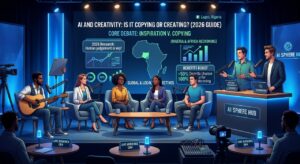
Who this affects: artists, writers, musicians, designers, and every creative professional now working alongside AI tools. What’s at stake: whether AI is a creative partner or a copyist, and who owns the result. When this came to a head: 2024 through mid-2026, as generative tools went from novelty to daily infrastructure. Where it plays out: globally, and distinctly in Nigeria, where a 2022 copyright law and a live fashion-industry dispute are testing the same questions. Why it matters: creative income, authorship, and legal protection all hinge on the answer. How courts and creators are responding: through fair-use rulings, new workflows, and a growing set of practical safeguards this article lays out.
- Does AI Help or Hurt Creative Work?
The honest answer is: it depends on who’s using it and when in the process they use it. A University of Houston study examined how generative AI shapes creativity across the design process, and found that AI is genuinely useful in the early ideation stage for both ordinary people and expert designers, because it can generate possibilities beyond what a person would imagine alone. But that same research found the picture gets more complicated later in the creative process, particularly for experienced designers who already have a defined style to protect.
A separate, large-scale empirical study analyzed over 4 million artworks from more than 50,000 users of a text-to-image platform. It found that artists who used generative AI saw creative productivity rise by 25% on average, and their work was 50% more likely to be favorited by viewers. Crucially, the researchers found the gains weren’t automatic, the artists who benefited most were the ones who explored many AI-generated options and then applied their own judgment to filter, edit, and refine what the tool produced.
Writers see a similar pattern. One study of 300 writers found that access to AI-generated ideas improved how their writing was rated for creativity, quality, and enjoyment with the largest gains among writers who were rated less creative to begin with. The takeaway across all of this research is consistent: AI expands the number of directions a creator can explore, but it doesn’t remove the need for taste, editing, and judgment. Those human skills are becoming more valuable, not less.
- The Adoption-Approval Gap
If AI genuinely helps, why do so many creatives remain uneasy about it? A 2026 global survey of 882 creative professionals found 86% now use AI tools in their work, yet only 10% believe AI’s overall effect on the creative industry is positive. Fifty-eight percent called the impact mixed, and 28% described it as straightforwardly negative.
The gap that defines this moment: near-universal AI adoption paired with near-universal unease about what it’s doing to pricing power, job security, and authorship. Creatives aren’t refusing AI — they’re adopting it because they feel they have no choice, while still questioning what it costs them long-term.
That unease is compounded by burnout. The same survey found 69% of creative professionals experienced burnout in the past 12 months, with mid-career creatives hit hardest at 77%. A separate global survey of 1,780 creative professionals found that nearly half now use AI daily, but flagged that the tools arrived faster than industry norms around disclosure, pricing, or attribution could catch up.
Where “Inspired By” Becomes “Copied From”
The legal line between AI-assisted creation and copyright infringement usually comes down to two separate questions: how a model was trained, and what it outputs. Training involves a model learning patterns from existing works. Output is what the model generates afterward. Courts have started treating these as distinct issues, and the rulings so far are more nuanced than either “AI training is always fair use” or “AI training is always theft.”
What US courts have actually decided
In Bartz v. Anthropic, the court found that training an AI model on copyrighted works can qualify as fair use, but only if those works were acquired legally the court drew a sharp line between lawful use of purchased or licensed material and the use of pirated copies. A similar case against Meta reached a comparable conclusion on training as “transformative,” though the court there diverged on how it treated pirated source material, and separately raised a concern that AI-generated output could flood the market with material similar enough to compete directly with the original works it learned from.
A different outcome emerged in Thomson Reuters v. Ross Intelligence, one of the earliest AI copyright rulings on the merits. There, the court found that using Westlaw’s legal headnotes to train a competing legal research tool was not fair use, largely because the resulting product directly substituted for the market Thomson Reuters already served. That market-substitution question does the AI’s output compete with and replace the original work? has become the recurring factor courts keep returning to.
Separately, New York Times v. OpenAI is testing a related but distinct question: whether a model can be prompted to reproduce substantial portions of a specific article nearly verbatim. That case remains unresolved and could set precedent on how far “transformative use” stretches once a model’s output starts to closely mirror an identifiable original.
Why this matters even if you’re not a lawyer
For working creatives, the practical lesson isn’t the legal theory, it’s the pattern. Using AI as a drafting or brainstorming tool sits in relatively safe territory. Publishing output that closely mirrors a specific, identifiable existing work is where risk rises sharply, regardless of what tool produced it.
- Nigeria and Africa: A Parallel Legal Reckoning
Nigeria’s Copyright Act 2022 defines a copyrightable work as an original creation of the author’s intellect, language that presupposes human effort. As a result, works produced entirely by AI, with minimal human involvement, may fall outside statutory protection under Nigerian law, raising real questions for creators leaning heavily on AI tools without adding substantial original input of their own.
This isn’t theoretical. A recent AMVCA-adjacent fashion dispute involving designer Almée Couture centered on whether a designer’s sketch showed enough independent creative transformation from an AI-generated source image to count as original work a live example of Nigerian courts and industry bodies having to apply human-originality tests to AI-assisted output for the first time.
At the same time, AI is becoming genuine creative infrastructure across the continent. A partnership launching in July 2026 will provide AI tools, training, and technical support to nearly 100,000 creators across Nigeria, South Africa, Ghana, Kenya, and Sierra Leone, reflecting how AI is lowering production costs for African filmmakers, musicians, and designers even as the legal framework around ownership lags behind.
- How Creators Can Protect Their Work and Use AI Responsibly
1. Document your human contribution. Keep drafts, prompts, and revision history showing where your judgment shaped the final work, this is the strongest evidence of originality under both US and Nigerian standards.
2. Use AI for exploration, not final output. The research is consistent: the biggest gains come from using AI to generate options, then applying your own editing and taste not publishing raw AI output unchanged.
3. Check a tool’s training data policy. Where a model sourced its training data increasingly matters legally, not just ethically.
4. Avoid prompts that target a specific existing work. Asking a model to closely imitate one named artist’s or writer’s specific piece is the pattern most likely to trigger market-substitution concerns.
5. Watch your local law, not just US headlines. Nigerian, Kenyan, and South African creators are operating under copyright frameworks that predate generative AI and may treat originality differently than US courts do.
Frequently Asked Questions
1. Is AI-generated art copyrighted?
In most jurisdictions, including the US and Nigeria, a work needs meaningful human authorship to qualify for copyright. Purely AI-generated output, with no human creative input, generally cannot be copyrighted. Work where a human directs, selects, arranges, or substantially edits AI output has a stronger claim to protection.
2. Can I get sued for using AI in my creative work?
Using AI as a tool is not inherently illegal. Legal risk rises when AI output closely reproduces a specific existing work, or when the training data behind a tool was obtained through piracy. Courts have so far focused on whether the output substitutes for the original work in the market.
3. Does using AI make me less creative?
Research shows mixed effects depending on skill level and stage of work. AI tends to boost idea generation for both beginners and experts, but can complicate later refinement stages for experienced creators who already have a strong personal style. The people who benefit most use AI to generate options and then apply their own judgment to filter and shape the result.
4. Is training AI on copyrighted work illegal?
US courts have found that training AI models on legally acquired copyrighted material can qualify as fair use, since it’s considered transformative. Training on pirated copies has been treated differently, and courts have flagged market substitution as a factor that could tip a case away from fair use.
5. Does Nigerian copyright law recognize AI-generated work?
The Nigerian Copyright Act 2022 defines copyrightable works as original creations of the author’s intellect, which presupposes human effort. Works produced entirely by AI, with minimal human involvement, likely fall outside this protection, leaving Nigerian creators exposed unless they can show clear original human contribution.