
Agentic AI is the shift from AI that answers to AI that acts and multi-agent systems are how enterprises are scaling that shift. Here’s who’s using it, what it costs, why most projects still fail, and what it means for Africa.

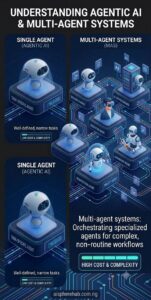
Agentic AI is software that plans a task, chooses its own tools, and carries out multiple steps toward a goal with little or no human approval in between. A multi-agent system takes that a step further: instead of one AI handling a task, several specialized agents divide the work, hand pieces to each other, and coordinate until the job is done. Both ideas moved from research demos to production software faster than almost any enterprise technology on record, and 2026 is the year analysts agree the shift became real rather than theoretical.
This matters right now because the numbers stopped being small. Gartner expects 40% of enterprise applications to embed task-specific AI agents by the end of this year, up from under 5% in 2025, an eightfold jump in twelve months. The global agentic AI market has climbed to roughly $9–11 billion in 2026 and multi-agent architectures specifically are growing faster than the category average. Below, you’ll find where this technology stands today, why it works the way it does, why so many pilots still stall before production, and what it means for businesses building in Nigeria and across Africa
- What Is Agentic AI?
Agentic AI refers to AI systems that can plan multi-step tasks, use tools and APIs, and take action toward a goal with limited human supervision this goes well beyond a chatbot that only answers questions. In practice, an agent combines four things: a reasoning model, memory of what it has already done, access to external tools, and guardrails such as human checkpoints for high-stakes actions.
The distinction that matters for anyone evaluating this technology is the difference between automation, assistance, and agency:
- Automation follows a fixed script useful for routine, repetitive workflows where the steps never change.
- An AI assistant retrieves information or drafts content but waits for a human to decide and act.
- An agent decides which tool to use, executes the action, checks the result, and adjusts its next step on its own.
Gartner’s own guidance to enterprises reflects this: use agents where they deliver clear, measurable value, use plain automation for routine workflows, and use simple assistants for basic retrieval. Matching the right architecture to the right task, rather than defaulting to the most autonomous option, is what currently separates high-performing deployments from failed pilots.
- What Is a Multi-Agent System (MAS)?
A multi-agent system is an architecture where multiple specialized AI agents work together under coordination one might research, another might draft, another might verify facts, and a fourth might execute a transaction to complete a workflow that would overwhelm a single generalist agent. Single-agent systems still dominate deployment today, holding roughly 59% of market share in 2025, largely because they are simpler and cheaper to run for well-defined, narrow tasks.
But the growth curve favors coordination. Multi-agent systems are projected to grow at a compound annual rate of roughly 48% through 2030 faster than the agentic AI market overall as enterprises push into workflows that genuinely require multiple specialties working in sequence or in parallel.
- The 2026 Numbers: Market Size, Adoption, and the Production Gap
Every serious analyst firm agrees on direction; they differ on scope, which is why the dollar figures vary. Some measure agent software alone, others include total agentic AI spend across infrastructure and services.
$9–11B
Global agentic AI market size in 2026, up from ~$7.3B in 2025
40%+
CAGR through 2030–2034 across most market forecasts
40%
Of enterprise apps will embed task-specific agents by end of 2026 (Gartner)
~23%
Of organizations have actually scaled agents into production
40%+
Of agentic AI projects forecast to be cancelled by end of 2027 (Gartner)
48.5%
Projected CAGR for multi-agent systems specifically, 2025–2030
The gap between those last two numbers 40% adoption intent and 23% real production use is the story underneath the story. Adoption is not the same as competence. Forrester’s analysis attributes most agent failures to architecture, not the underlying model: unclear success criteria, weak tool and data access, missing guardrails, and thin evaluation discipline. That is a project-management problem as much as a technology problem, and it explains why Deloitte’s 2026 research found only about one in five companies has a mature governance model for autonomous agents.
- The Protocols Making Multi-Agent Systems Possible: MCP and A2A
Multi-agent systems only work at scale if agents built by different vendors, on different models, can actually talk to each other and to the tools they need. Two open protocols now do that job, and understanding the difference between them is close to essential for anyone writing or building in this space.
Model Context Protocol (MCP)
Anthropic released MCP in November 2024 to standardize how an AI agent connects to external tools, data sources, and services effectively the interface between an AI model and its “hands.” The protocol has since been donated to the Linux Foundation’s Agentic AI Foundation and adopted across competing platforms, including OpenAI, Google DeepMind, and Microsoft. By mid-2026, MCP had passed roughly 97–110 million monthly downloads, a scale that makes it the de facto standard for agent-to-tool connections.
Agent2Agent (A2A)
Google introduced A2A in April 2025 to solve a different problem: how agents discover, message, and delegate tasks to other agents, regardless of vendor, framework, or hosting cloud. Donated to the Linux Foundation in mid-2025 and reaching version 1.0 in early 2026, A2A now counts more than 150 supporting organizations, including AWS, Microsoft, Salesforce, SAP, and ServiceNow.
The simplest way to remember it
MCP is how an agent uses its tools. A2A is how two agents shake hands. A serious multi-agent deployment in 2026 typically runs both: MCP gives each agent its capabilities, and A2A lets those agents work together across departmental and vendor boundaries.
- Where Agentic AI Is Delivering Real ROI Right Now
Return on investment remains uneven and concentrated. Roughly 23% of organizations report significant ROI from AI agents specifically, compared with about 29% from generative AI overall, and customer service consistently shows the fastest payback because the use case is narrow, measurable, and high-volume.
Highest-performing use cases in 2026
- Customer service and support triage — highest measurable deflection savings and fastest payback period.
- Coding and technical work — the heaviest real-world usage category, representing roughly a third of all Claude.ai activity according to Anthropic’s own Economic Index.
- Compliance and fraud detection in finance — particularly strong in markets with API-first banking infrastructure.
- Multi-stage internal workflows — more than half of surveyed organizations now run agents across multi-step processes, with 16% running agents across multiple departments simultaneously.
- Why Most Agentic AI Projects Still Fail
The failure rate is not a secret, and it is not really about the AI model. Analysts converge on the same root causes:
1. Unclear success criteria. Teams deploy an agent without defining what “done, correctly” looks like.
2. Weak governance. Only about one in five organizations has a mature framework for auditing and controlling what autonomous agents are permitted to do.
3. Treating agents like ordinary software. An agent that can send emails, move money, or trigger workflows is a privileged system and needs the access controls of one — clear permissions, defined boundaries, audit trails.
4. Skipping the incremental path. Practitioners such as Andrew Ng have repeatedly stressed starting with narrow, task-specific agents before attempting broad autonomous workflows, rather than the reverse.
The takeaway: Gartner projects more than 40% of current agentic AI projects will be cancelled by the end of 2027, driven by cost, unclear business value, and inadequate risk controls, not by the AI underperforming on the tasks it was actually well-scoped to do.
- Agentic AI in Africa and Nigeria: The Adoption Paradox
Africa’s agentic AI story runs on a genuine paradox. A March 2026 report found that 88% of African organizations are now embedding AI agents into their operations, a headline adoption figure that rivals or exceeds many wealthier markets. But adoption and competence are not the same thing, and the region’s competitive advantage is accruing to organizations that have moved past pilot projects into what industry events are now calling “predictive intelligence”: using real-time data to automate risk assessment, underwriting, and credit decisioning before a customer even applies.
Nigeria specifically shows a sharper version of the same split. The 2026 Ataraxis Global Outsourcing AI Readiness Index ranks Nigeria 6th globally in workforce AI literacy ahead of every other African market yet just 19th globally in enterprise AI adoption, a 32-point gap that is the widest of any country the index measures. In plain terms: Nigerian professionals are teaching themselves to use AI faster than Nigerian companies are building it into how they operate.
What’s actually working
1. Fintech and banking compliance the Central Bank of Nigeria’s March 2026 mandate now requires AI-powered compliance systems across financial institutions, directly accelerating agent deployment in fraud detection and anti-money-laundering workflows.
2. Local-language agents — companies including CDIAL AI (Nigeria) and grace ai lab (Lagos) are building agents that operate in Yoruba, Hausa, Igbo, and Nigerian Pidgin, addressing a gap global vendors have largely ignored.
3. Mobile-money-native infrastructure — because much of African finance already runs through API-first mobile money systems, agents can plug into payment and disbursement workflows with far less legacy integration work than in Western markets with older core banking systems.
For Nigerian founders and content teams building AI-adjacent products, the practical opportunity isn’t competing with global agent platforms on raw capability, it’s the localization, language, and compliance layer that global vendors are structurally slow to build.
- TAKEAWAYS
1. Agentic AI is a capability (plan, use tools, act); multi-agent systems are an architecture (multiple agents coordinating).
2. The 40% adoption-intent figure and the 23% production-scale figure both come from credible 2026 research cite both, not just the flattering one.
3. MCP and A2A are complementary, not competing — most serious deployments in 2026 run both.
4. Governance, not model quality, is the leading cause of project failure and cancellation.
5. Africa’s adoption rate is high on paper; the real differentiator is production maturity and local-language, compliance-ready deployment.
Frequently Asked Questions
1. What is agentic AI in simple terms?
Agentic AI is software that can plan a multi-step task, use tools or APIs on its own, and take action toward a goal without a human approving every step. It goes beyond a chatbot that only answers questions.
2. What is the difference between agentic AI and a multi-agent system?
Agentic AI describes the capability: a single AI system that can plan, use tools, and act autonomously. A multi-agent system is an architecture where several of these agents, often with different specializations, coordinate together to complete a larger workflow that no single agent could handle alone.
3. What is MCP in AI agents?
The Model Context Protocol (MCP) is an open standard, created by Anthropic and now governed by the Linux Foundation, that defines how an AI agent connects to external tools, data sources, and services. It functions as the standard interface between an AI model and the systems it needs to act on.
4. Why do most agentic AI projects fail?
Most failures are architectural rather than model-related. Analysts point to unclear success criteria, poor tool and data access, weak guardrails, and insufficient evaluation discipline as the primary causes, not the underlying AI model’s capability.
5. Is agentic AI relevant for Nigerian and African businesses?
Yes. A March 2026 report found that a large majority of African organizations are already embedding AI agents into operations, particularly in fintech, banking compliance, and customer service, where mobile-money infrastructure and API-first systems make agent deployment comparatively easy.
Grok AI Explained: Elon Musk’s Chatbot, Features, Pricing & Real Use Cases