
The global landscape of public safety and privacy is shifting rapidly. Today, governments and private corporations are supercharging AI surveillance systems to monitor, track, and analyze human behavior in real-time. By combining high-definition mesh camera networks, advanced facial recognition, and predictive AI algorithms, authorities can now anticipate actions before they happen. AI has moved surveillance from passive recording to active, real-time identification, facial recognition, gait tracking, and data-broker pipelines that follow you from your driveway to the checkout counter. Why now? Cheaper computer vision, bigger biometric databases, and loosened oversight rules have all converged at once. Where is this happening? From US border checkpoints to Lagos traffic cameras to Beijing crowd-monitoring systems. How does it work? AI systems process thousands of video feeds simultaneously, cross-reference biometric databases, and flag people as “suspicious” without a human ever reviewing the footage first.

- What Is AI Surveillance, and Why Is It “Supercharged” Now?
AI surveillance means using machine learning to automatically detect, identify, and track people at a scale no human team could match. That’s the core shift in 2026: detection used to need a person watching a screen. Now, a single AI system can process thousands of video feeds simultaneously, identify individuals across multiple cameras, and flag “suspicious” behavior patterns automatically capabilities that were simply impossible with human-only surveillance.
The “supercharging” part comes from three things happening together: falling computer vision costs, exploding biometric databases, and governments actively funding faster deployment. In the US, the Trump administration’s national AI policy framework, released in March 2026, pushes for wider AI deployment across industry while discouraging state-level regulation that might slow it down.
- From Passive Cameras to Active Identification
A decade ago, a security camera just recorded. Today, that same camera can identify a face, cross-check it against a database of over 70 billion data points, and alert an officer within seconds. Clearview AI, the company behind much of this shift, claims over 99% accuracy in facial matching, and its technology is now embedded directly into daily intelligence work at agencies like US Customs and Border Protection.
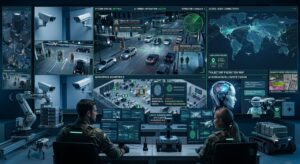
The Core Pillars of Modern AI Surveillance
1. Computer Vision and Real-Time Behavioral Analysis
Legacy CCTV networks required human operators to monitor screens. Today, computer vision algorithms scan thousands of feeds simultaneously. These systems detect “anomalous behavior” such as loitering, sudden pacing, or abandoned objects and instantly alert law enforcement.
2. Pervasive Biometrics and Facial Recognition
Facial recognition is no longer confined to airport security checkpoints. Live facial recognition (LFR) is actively deployed on public streets. These AI models convert facial geometry into mathematical code, comparing pedestrians against watchlists within milliseconds.
3. Predictive Policing and Big Data Fusion
By aggregating data from social media, arrest records, and geolocated phone pings, predictive AI models generate risk scores for specific geographic areas or individuals. While proponents argue this optimizes resource allocation, critics point out that it creates feedback loops of over-policing.
- Gait Recognition: The Technology That’s Nearly Impossible to Dodge
Gait recognition identifies someone by how they walk stride length, posture, movement rhythm and it works even when a face is covered. China’s Watrix system, active in Beijing and Shanghai, uses this for suspect tracking and crowd monitoring at large public events. Unlike facial recognition, which a mask can defeat, gait analysis doesn’t care what you’re wearing on your face.
- The US Case: Mission Creep at DHS
What started as border-security tooling has moved inward. Procurement records reviewed by the American Immigration Council show Homeland Security spending $30 million on Palantir’s ImmigrationOS for granular tracking, $4.6 million on iris-scanning smartphones, and $3.75 million on ICE’s largest-ever Clearview AI contract.
One app called Mobile Fortify pulls from a database of over 200 million images across DHS, the FBI, and the State Department, and it has reportedly been used on US teenagers who weren’t carrying ID. Senator Ron Wyden has warned the tooling could let agencies “trample on the rights of Americans,” and EPIC’s Maria Villegas Bravo has flagged likely First and Fourth Amendment issues. Senator Ed Markey introduced legislation in February 2026 to ban DHS and ICE from domestic biometric surveillance altogether, a sign Congress is taking the mission-creep concern seriously.
Frequently Asked Questions (FAQs)
1. What is AI surveillance?
AI surveillance refers to the use of artificial intelligence, computer vision, and machine learning algorithms to automatically monitor, analyze, and track video feeds, biometric data, and digital footprints without requiring human intervention.
2. How is AI used in public surveillance?
AI is integrated into public surveillance through live facial recognition, automated license plate readers (ALPR), behavioral anomaly detection, and predictive policing software designed to forecast criminal activity.
3. Is AI surveillance legal?
The legality depends entirely on your jurisdiction. In the United States, regulations are fragmented across states, allowing police widespread use of facial recognition. In contrast, the European Union’s AI Act places strict prohibitions on real-time biometric surveillance in public spaces, with very narrow exceptions for national security.
4. How does AI surveillance impact everyday privacy?
It effectively eliminates public anonymity. When high-resolution cameras are coupled with AI, your movements can be tracked across a city, creating a detailed timeline of your associations, habits, and daily routines.
5. Can AI surveillance models make mistakes?
Yes. Multiple studies have shown that facial recognition algorithms exhibit higher error rates when analyzing women and people of color, which can lead to misidentification and wrongful arrests.
6. What are the biggest risks of AI-powered surveillance?
Weak legal oversight, algorithmic bias in facial recognition, mission creep where narrow-purpose tools get reused for broad population monitoring, and a lack of independent bodies to investigate abuse.
The Future of Robots: How Humanoid AI Robots Will Reshape Work by 2030