
The future of robots is no longer a lab demo. It is a factory floor in Spartanburg, a BotQ production line in California, and a $110 billion market taking shape in real time.
TABLE OF CONTENTS
1. The State of Robots in 2026
2. The Humanoid Robot Race: Tesla, Figure, and the Rest
3. Why the Real Breakthrough Is the AI Brain, Not the Body
4. How Big the Robot Market Will Actually Get
5. What the Future of Robots Means for Jobs
6. The Future of Robots in Africa and Nigeria
7. Risks, Failures, and the Reality Check
8. What to Watch Next
9. FAQs
Twelve months ago, a humanoid robot walking a factory floor was still mostly a marketing video. Today, it is a line item in BMW’s production report. The future of robots is arriving faster than most industry forecasts predicted, driven by cheaper sensors, better AI models, and a wave of capital that treats humanoid machines as the next trillion-dollar hardware category after the smartphone.
This shift is not just about Tesla’s Optimus or Figure AI’s humanoids anymore. It spans industrial arms welding car doors, warehouse robots sorting packages, and service robots mopping floors in Lagos malls. Some of it is already profitable. Much of it is still unproven. This guide separates the two, using verified 2026 data instead of hype.
Takeaway: The global robotics market is on track to more than double from roughly $45 billion in 2024 to $110.7 billion by 2030, and humanoid robots are shifting from research demos to paid industrial deployments for the first time in the technology’s history.
- The State of Robots in 2026
Robots have quietly moved past the “impressive demo” phase into measurable, revenue-generating deployment. The clearest evidence sits inside BMW’s Spartanburg plant, where Figure’s robots helped build over 30,000 X3 vehicles during a 10-month deployment, and the company is now expanding the program to a second plant. That is not a pilot. That is a paying industrial customer running robots on a real production line, at scale, for months.
Tesla has moved differently. As of early 2026, the company had announced cumulative production of over 50,000 Optimus units, while Figure AI had surpassed 10,000 deployments across partner warehouses. Tesla’s robots, though, remain largely internal, used inside its own factories rather than sold to outside customers. Musk himself has acknowledged that Optimus is “not in usage in our factories in a material way” as of his most recent earnings call comments on the program.
Outside the humanoid headlines, the unglamorous side of robotics keeps compounding. There will be nearly 13 million robots in circulation globally by 2030, spanning industrial arms, mobile warehouse robots, cobots, humanoids, and exoskeletons. Mobile robots, not humanoids, currently generate the most shipments and revenue of any robot category.
The Humanoid Robot Race: Tesla, Figure, and the Rest
The humanoid robot race in 2026 has three distinct tiers: companies proving commercial traction, companies proving manufacturing scale, and companies still proving the concept works at all.
- Tesla Optimus: Scale Ambition, Unproven Traction
Tesla’s strategy is industrial in the literal sense. The company is ending Model S and Model X production in Q2 2026 to convert Fremont factory capacity for Optimus manufacturing, a decision Musk framed as moving Tesla “into a future that is based on autonomy.” The latest hardware, Optimus V3, ships with 22-degree-of-freedom hands, Tesla’s new AI5 chip, and Grok voice AI, with low-volume production targeted for Fremont in summer 2026. Musk’s long-term price target has tightened to below $20,000 at scale, which would undercut a base Model 3.
The catch is real-world proof. Independent trackers scoring both companies on public evidence found Tesla scored 45.1 out of 100 against Figure’s 78.9, with the gap driven mainly by real-world commercial traction rather than raw hardware specs. Several high-profile Optimus demonstrations have also drawn scrutiny for apparent teleoperation rather than full autonomy.
- Figure AI: Fastest From Demo to Factory Floor
Figure has taken the opposite path: slower marketing, faster deployment. The company’s Figure 03 humanoid reached a sustained production rate of one robot per hour at its BotQ factory, a 24x throughput increase achieved in under 120 days. Those robots are already earning revenue in paid commercial pilots with partners including BMW.
- Boston Dynamics, Unitree, and the Rest of the Field
Boston Dynamics retired its hydraulic Atlas research platform and now leases a fully electric, commercially oriented version, recently changing ownership after Hyundai Motor Group moved to acquire SoftBank’s remaining 9.65% stake in the company for roughly $325 million. China’s Unitree, meanwhile, leads on volume rather than showmanship, having shipped over 5,500 units in 2025 with targets of 10,000 to 20,000 or more for 2026. Norway’s 1X has taken a consumer angle with its NEO home robot, and China’s AgiBot has run multi-day livestreamed factory trials to demonstrate sustained real-world reliability rather than staged demos.
- Why the Real Breakthrough Is the AI Brain, Not the Body
Hardware headlines dominate coverage, but the harder problem was always software. A robot with strong hands and weak perception is still just an expensive mannequin. What has actually changed in 2026 is the arrival of foundation models purpose-built for physical control, the same transformer-based approach that reshaped language AI now being applied to movement, grasping, and spatial reasoning.
Industry analysts describe this shift plainly: hardware advances are only half the story, and what truly upgrades humanoid robots from expensive remote-controlled toys into autonomous labor is the breakthrough in robot foundation models. Tesla’s approach leans on repurposed self-driving perception systems, while NVIDIA’s Isaac platform is pushing toward multi-robot coordination, with enterprise-grade validation cases expected before the end of 2026.
- How Big the Robot Market Will Actually Get
Market forecasts vary by methodology, but the direction is consistent across every major research firm. The global robotics market, spanning industrial, service, and humanoid categories, is projected to reach $110.7 billion by 2030, a 2.5x increase over 2024’s $45 billion base, representing a 13.8% compound annual growth rate.
Break that down by category and a clearer picture emerges. Industrial robotics alone is forecast to grow from roughly $18.8 billion in 2025 to $39 billion by 2035, while the broader service robotics segment, covering everything from hospital assistants to hotel delivery robots, is projected to expand from $62.85 billion in 2025 to $233.8 billion by 2035. Asia-Pacific dominates on both fronts, driven by China, Japan, and South Korea’s manufacturing bases.
- What the Future of Robots Means for Jobs
The honest answer is sector-specific, not universal. Adoption is concentrating in industries with structured environments, repetitive tasks, labor shortages, and high injury rates, rather than spreading evenly across the economy.
Automotive manufacturing is the clearest proving ground, with Tesla, BMW, and Hyundai all running humanoid pilots on assembly lines.
Warehousing and logistics face acute pressure, with roughly 500,000 unfilled U.S. warehousing positions as of early 2026 creating direct demand for robotic labor.
Construction is at the earliest pilot stage, with several companies testing humanoid robots for site tasks.
Displacement fears are real but currently outpaced by labor shortages in these specific sectors. The more accurate framing for 2026 is augmentation of understaffed roles, not wholesale replacement of a workforce.
- The Future of Robots in Africa and Nigeria
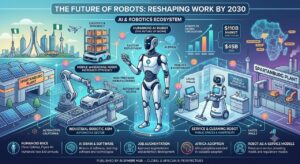
Robotics adoption in Africa remains early-stage, but the direction is set by the same forces reshaping global manufacturing: labor cost, infrastructure gaps, and a young, fast-growing workforce that AI-era automation will eventually intersect with. Nigeria’s manufacturing sector, still dominated by manual assembly and informal labor, is unlikely to see humanoid robots on factory floors before 2030. The near-term opportunity is narrower and more practical.
Service robotics, cleaning robots, hotel and hospitality delivery units, and agricultural automation are far more likely entry points for African markets than humanoid factory labor, mirroring the pattern already visible in Asia-Pacific’s dominant service robotics growth. Nigerian tertiary institutions, including engineering and mechatronics departments at universities such as Obafemi Awolowo University, are increasingly exposed to robotics and AI coursework, positioning a generation of Nigerian engineers to work on integration and maintenance roles rather than raw manufacturing, even if the robots themselves are built abroad. The realistic near-term African robotics story is one of import, integration, and skilled-labor upskilling, not domestic robot manufacturing.
- Risks, Failures, and the Reality Check
No credible future-of-robots story skips the failures. Early 2026 deployments have already produced real incidents, none catastrophic, but instructive. Documented near-misses include a Tesla Optimus unit dropping a battery module during a restricted-area pick-and-place operation, a Figure 02 robot stalling mid-task and blocking a warehouse aisle for three hours, and an Atlas unit losing balance on a slippery surface during a live demonstration.
Skepticism from robotics veterans is also worth taking seriously. Roboticist Rodney Brooks, cofounder of Roomba maker iRobot, has called the vision of humanoid robots as universal catchall assistants “pure fantasy thinking,” arguing robots remain fundamentally coordination-challenged. That critique does not invalidate the industrial progress described above, but it is a useful counterweight to manufacturer press releases.
- What to Watch Next
Tesla’s summer 2026 Fremont ramp, which will be the first real test of whether Optimus can hold up in 24/7 factory conditions rather than staged demos.
Figure’s BotQ scaling beyond one robot per hour, and whether reliability holds at customer sites over multi-year deployments, not just pilot windows.
Robot-as-a-Service pricing models, expected to mature by 2027, which would let smaller manufacturers rent robotic labor instead of buying it outright.
Frequently Asked Questions
1. Will robots replace human jobs by 2030?
Not broadly. Adoption is concentrated in structured, labor-short sectors like automotive manufacturing and warehousing, where robots are filling unfilled positions rather than displacing existing workers at scale.
2. Which company is actually ahead in humanoid robots, Tesla or Figure?
On commercial deployment, Figure AI is currently ahead, with paid industrial pilots at BMW already running. Tesla leads on manufacturing scale ambition and custom AI silicon but has not yet proven external commercial traction.
3. How big will the robotics market be by 2030?
The global robotics market is projected to reach approximately $110.7 billion by 2030, more than double its 2024 size, with roughly 13 million robots in circulation worldwide.
4. When will humanoid robots be available for home use?
Consumer humanoid robots are still early. Norway’s 1X has opened preorders for its NEO home robot with 2026 delivery targets, but most humanoid deployment remains industrial and enterprise-focused through the rest of the decade.
5. Is humanoid robot adoption realistic for Africa and Nigeria?
Full humanoid factory adoption is unlikely before 2030. Service robotics, agricultural automation, and skilled integration and maintenance roles are the more realistic near-term entry points for African markets.