
After a sudden global shutdown that caught developers off guard, Claude Fable 5 is back and this time, it’s not the same model you used before.
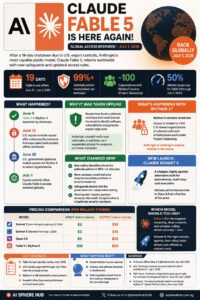
Claude Fable 5 is available again. Three weeks after a U.S. government directive forced Anthropic to pull its most capable public model offline worldwide, access to Claude Fable 5 resumes globally on July 1, 2026, alongside the launch of a new, cheaper model called Claude Sonnet 5. Here’s what actually happened, what’s different this time, and what it means if you’re building on Claude.
TABLE OF CONTENTS
* Claude Fable 5 returns worldwide on July 1
* Why Fable 5 was pulled offline
* What’s happening with Claude Mythos 5
* Claude Sonnet 5: a cheaper, agentic alternative
* Fable 5 vs. Sonnet 5 vs. Opus 4.8: pricing compared
* FAQs
- Claude Fable 5 returns worldwide on July 1
Anthropic confirmed the news on June 30, first on X and then in a full blog post: the U.S. Department of Commerce has lifted the export controls that forced Claude Fable 5 and its more powerful sibling, Claude Mythos 5, offline. Restoration began the following day, July 1, 2026, across four surfaces the Claude Platform, Claude.ai, Claude Code, and Claude Cowork.
The rollout isn’t a simple on/off switch. Anthropic laid out specific terms for how access resumes:
- Pro, Max, Team, and select Enterprise plans get Fable 5 at 50% of standard weekly usage limits through July 7, 2026.
- After July 7, access moves to a usage-credits system rather than the original launch terms.
- Cloud availability — AWS, Google Cloud, and Microsoft Foundry returns “as quickly as possible,” per Anthropic, without a fixed date.
If you don’t see Fable 5 in your model picker the moment July 1 begins, that’s expected. Rollouts stagger by region, so users outside the U.S. may see access arrive several hours later in the day.
- Why Fable 5 was pulled offline in the first place
The shutdown traces back to a report from Amazon researchers who identified a jailbreak method capable of steering Fable 5 toward identifying software vulnerabilities and in at least one documented case, generating exploit-style code. U.S. officials treated this as a national security concern significant enough to require an immediate compliance directive.
The directive itself created an unusual problem. It required Anthropic to restrict access based on user nationality, but the company had no real-time way to verify who was a foreign national and who wasn’t. Rather than risk noncompliance, Anthropic suspended Fable 5 and Mythos 5 for every user, everywhere, on June 12, just three days after their June 9 launch.
- What Anthropic changed before bringing it back
Fable 5 now ships with additional safety classifiers tuned specifically against the jailbreak pattern Amazon flagged. Anthropic says these classifiers catch the technique in more than 99% of attempts. The tradeoff is a more cautious model: expect a modest rise in false positives on legitimate security research, debugging, and vulnerability-testing workflows.
Anthropic is also pushing for industry-wide standardization here. Working alongside Amazon, Microsoft, Google, and other Project Glasswing partners, the company proposed a shared framework for grading jailbreak severity across four axes:
* Capability gain — how much more an attacker can do compared with existing tools
* Scope — the number of distinct offensive tasks the technique unlocks
* Ease of weaponization — how much human effort turns the jailbreak into a real attack
*Discoverability — how easily the technique can be found or reproduced
Anthropic also committed to sharing its new safeguards with the government for independent testing and to submitting threat intelligence reports before publication, feeding into the interagency vulnerability-sharing center created under the June 2 executive order.
- What’s happening with Claude Mythos 5
Mythos 5 is not returning to the public. It shares Fable 5’s underlying capabilities but skips the safety classifiers entirely, which is exactly why regulators are treating it with more caution. Following government approval on June 26, Anthropic restored Mythos 5 access to roughly 100 trusted U.S. organizations working in cybersecurity and critical infrastructure, under Project Glasswing.
Anthropic says it’s continuing talks to widen that list, including restoring access for foreign organizations that had it before the June 12 shutdown. For now, though, Mythos 5 stays a closed-circle tool, if your organization isn’t already part of Glasswing, Fable 5 is the model available to you.
- Claude Sonnet 5: a cheaper, agentic alternative
Anthropic didn’t just restore what it had, it shipped something new alongside it. Claude Sonnet 5, described by Anthropic as its most agentic Sonnet-class model to date, launched on June 30. It’s built around autonomous, multi-step task execution: planning, using tools like browsers and terminals, and completing work with minimal supervision, pushing it closer to Opus-tier behavior than earlier Sonnet models.
The real headline, though, is cost. Sonnet 5 is positioned as delivering performance close to Opus 4.8 at a fraction of the price, making it the practical choice for teams running high-volume agentic workloads where every token counts.
- Fable 5 vs. Sonnet 5 vs. Opus 4.8: pricing compared
Here’s how the three models stack up on API pricing as of July 1, 2026:
[ PRICING COMPARISON — PER MILLION TOKENS ]
┌──────────────────────────────┬────────────┐
│ MODEL │ INPUT ($) │ OUTPUT ($) │
├───────────────────────┼────────────┤
│ Sonnet 5 (Intro) │ 2 │ 10 │
│ Sonnet 5 (Standard) │ 3 │ 15 │
│ Opus 4.8 │ 5 │ 25 │
│ Fable 5 / Mythos 5 │ 10 │ 50 │
└─────────────────────┴────────────┴────────────┘
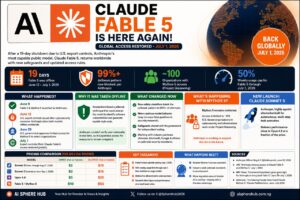
Sonnet 5 (model ID claude-sonnet-5) is live now on Free, Pro, and Max plans, as well as through the API. The introductory pricing holds until August 31, 2026, before shifting to standard rates.
- Which model should you actually use?
If your workload involves long-horizon reasoning, deep research, or complex multi-file coding tasks where accuracy matters more than cost, Fable 5 remains the strongest publicly available option. For high-volume, agentic, tool-using workflows think automated QA, scraping-and-summarizing pipelines, or customer-facing agents, Sonnet 5’s price-to-performance ratio makes it the more sustainable default.
- Frequently Asked Questions
1. Is Claude Fable 5 available again?
Yes. Anthropic restored Claude Fable 5 access worldwide on July 1, 2026, after the U.S. Department of Commerce lifted the export controls that had forced it offline on June 12.
2. Why was Claude Fable 5 taken offline in the first place?
U.S. officials cited cybersecurity risk after a jailbreak technique, surfaced in an Amazon researcher report, could prompt the model toward vulnerability identification and exploit-style code. Anthropic couldn’t verify user nationality in real time, so it suspended access for everyone rather than risk noncompliance.
3. What’s the usage limit for Fable 5 after it returns?
Pro, Max, Team, and eligible Enterprise plans can use Fable 5 up to 50% of standard weekly usage limits through July 7, 2026. After that date, access shifts to a usage-credits system.
4. Is Claude Mythos 5 available to everyone now too?
No. Mythos 5 remains restricted to a limited set of Project Glasswing organizations roughly 100 U.S.-based partners in cybersecurity and infrastructure work following government approval on June 26, 2026. Anthropic says it’s working to expand this list.
5. How is Claude Sonnet 5 different from Fable 5?
Sonnet 5 is a smaller, cheaper, highly agentic model launched alongside Fable 5’s return. It costs $2 per million input tokens and $10 per million output tokens at introductory pricing, versus $10/$50 for Fable 5, making it the practical choice for high-volume agentic tasks.
6. What changed in Fable 5’s safeguards since June 9?
Anthropic added safety classifiers that detect and decline the jailbreak pattern Amazon researchers identified, in more than 99% of attempts. Mythos 5 does not include these classifiers, which is why its access remains far more restricted.
Reported by the AI Sphere Hub editorial team. AI Sphere Hub covers frontier AI developments, model releases, and the tools shaping how developers build with AI. Follow us on X at @aispherehub.
Google Gemini’s Personalized AI Image Generation Is Now Free for U.S. Users