
If you’ve spent any time searching for the best programming language to learn in 2026, you’ve probably noticed that every list gives you a different answer. That’s because there isn’t one correct language, there’s a correct language for your goal, your timeline, and the kind of work you actually want to do. This guide ranks the languages that matter most this year, explains who each one is genuinely best for, and accounts for the one variable most 2025-era guides ignore: AI coding assistants have changed what “learning to code” means.
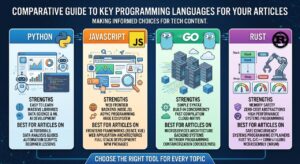
- How We Ranked the Best Programming Languages for 2026
Every language below was evaluated against four practical criteria rather than hype: current job demand across job boards and developer surveys, salary potential, learning curve for someone starting fresh, and relevance in an AI-assisted development workflow where tools like Claude Code and GitHub Copilot write a growing share of boilerplate. A language that scores well on all four is a safer long-term bet than one that’s trending but narrow.
- The Best Programming Languages to Learn in 2026, Ranked
1. Python — Best Overall, Best for AI and Data
Python remains the most versatile language to learn in 2026, and its lead has widened rather than narrowed as AI adoption accelerates. Its clean, readable syntax makes it approachable for absolute beginners, while libraries like NumPy, Pandas, and TensorFlow keep it indispensable for data science, machine learning, automation, and backend development. If your interest leans toward AI, analytics, or general-purpose scripting, Python is the lowest-risk starting point.
Best for: AI/ML, data science, automation, backend APIs, career changers. Learning curve: Easy to moderate.
2. JavaScript and TypeScript — Best for Web and Full-Stack Roles
JavaScript still powers nearly every interactive website, and pairing it with TypeScript has become close to a standard expectation for full-stack roles in 2026. TypeScript’s static typing catches errors before they reach production, which is part of why companies increasingly list it as a requirement rather than a bonus. Beginners get the advantage of instant visual feedback in a browser, which keeps motivation high in the early, frustrating weeks of learning to code.
Best for: Web development, full-stack engineering, frontend frameworks like React. Learning curve: Easy to start, moderate to master.
3. Go (Golang) — Best for Cloud and Backend Infrastructure
Go was built at Google specifically to solve large-scale, concurrent systems problems, and in 2026 it’s the default choice for cloud-native infrastructure, microservices, and high-throughput backend systems. It compiles to a single binary, starts almost instantly, and has a small, opinionated standard library that keeps the learning curve manageable compared to other systems languages. Demand is strong and growing wherever companies standardize on containers and distributed systems.
Best for: Cloud infrastructure, DevOps tooling, backend services at scale. Learning curve: Easy to moderate.
4. Rust — Best for Systems and Security-Critical Software
Rust continues to top developer “most admired” surveys for good reason: it delivers near-C performance with compile-time guarantees that eliminate entire categories of memory-safety bugs. Enterprises are adopting it for critical infrastructure and secure systems programming, and salaries reflect that scarcity. It is not a beginner-friendly first language because of concepts like ownership and borrowing, but for anyone targeting systems programming, security engineering, or performance-sensitive infrastructure, it’s one of the highest-leverage languages to add in 2026.
Best for: Systems programming, security engineering, performance-critical software. Learning curve: Steep.
5. Java — Best for Enterprise and Android
Java isn’t trendy, but it’s durable. Banks, insurance systems, large enterprises, and a huge share of Android development still run on Java, and its open-source ecosystem and platform independence keep it relevant for structured, scalable applications. It’s a strong choice if your goal is stability and enterprise employability rather than startup speed.
Best for: Enterprise software, banking systems, Android development. Learning curve: Moderate.
6. SQL — The Non-Negotiable Companion Skill
SQL isn’t usually framed as a “language to learn” in the same sense as the others, but it remains essential in 2026 regardless of which primary language you choose. Nearly every application touches a database, and SQL is the language purpose-built for querying and structuring that data efficiently. Pairing any general-purpose language with solid SQL and database design skills makes you significantly more employable.
Best for: Every developer, regardless of specialization. Learning curve: Easy.
7. Kotlin and Swift — Best for Mobile Development
Kotlin has become the standard for modern Android development, while Swift remains the primary language for native iOS, iPadOS, and macOS apps. If mobile development is your specific goal, these are more direct paths than a general-purpose language, though many mobile teams also rely on Flutter and Dart for cross-platform apps that target both ecosystems from a single codebase.
Best for: Native mobile apps (Android: Kotlin, Apple: Swift). Learning curve: Moderate.
- How to Choose the Right Language for Your Goal
Instead of chasing whichever language trends on social media this month, work backward from the outcome you want:
- Want to work in AI, data, or automation? Learn Python first.
- Want to build websites or full-stack products? Learn JavaScript, then add TypeScript.
- Want to work in cloud infrastructure or DevOps? Learn Go after a general-purpose language.
- Want systems, security, or performance engineering? Learn Rust after you have at least one other language under your belt.
- Want stable enterprise or banking-sector work? Learn Java.
- Want native mobile apps? Learn Kotlin for Android or Swift for iOS.
Your first language is a launchpad, not a life sentence. Once you understand core programming logic, picking up a second or third language becomes significantly faster.
- How AI Coding Tools Are Changing What “Learning to Code” Means
It’s tempting, with tools like Claude Code and GitHub Copilot writing functional code from a plain-language prompt, to assume fundamentals no longer matter. The opposite is closer to true. When you use an AI coding assistant, you become the human in the loop who has to evaluate, test, and take responsibility for what it produces. Developers with little understanding of the underlying language are poorly positioned to catch a subtle bug, an insecure pattern, or an outdated library suggestion in AI-generated code. The developers thriving in 2026 are the ones using AI to move faster on work they already understand, not as a replacement for understanding it.
Frequently Asked Questions
1. What is the single best programming language to learn in 2026?
There isn’t one universal answer, but Python is the closest thing to a safe default in 2026 because of its readable syntax and dominance in AI, data, and automation work. JavaScript, paired with TypeScript, is the better choice if your goal is web or full-stack development.
2. Is it still worth learning to code in 2026 with AI tools like Claude Code and Copilot available?
Yes. AI coding assistants speed up writing code but don’t remove the need to understand what that code does. Developers who can read, test, and debug AI-generated code are more employable than those who can only prompt for it.
3. Should a complete beginner start with Python or JavaScript?
Python is generally easier for absolute beginners because of its clean syntax, while JavaScript gives instant visual feedback in a browser, which keeps many new learners motivated. Choose Python for data, AI, or backend goals, and JavaScript for web or front-end goals.
4. Which programming languages are most in demand in Nigeria in 2026?
JavaScript and TypeScript lead demand across Nigerian startups and fintechs, followed by Python for backend and data roles, Java for banking and enterprise systems, and Go at high-scale fintech companies. Kotlin and Flutter/Dart are growing fast for mobile development.
5. Is Rust worth learning in 2026?
Rust is worth learning if you’re targeting systems programming, security engineering, or performance-critical infrastructure roles. It has a steep learning curve and isn’t recommended as a first language, but it commands strong salaries and is increasingly adopted for safety-critical software.
6. How long does it take to learn a programming language well enough to get a job?
Most career changers reach an entry-level, job-ready standard in six to twelve months of consistent, project-based practice, though this varies by prior experience, language choice, and how much time is invested weekly.